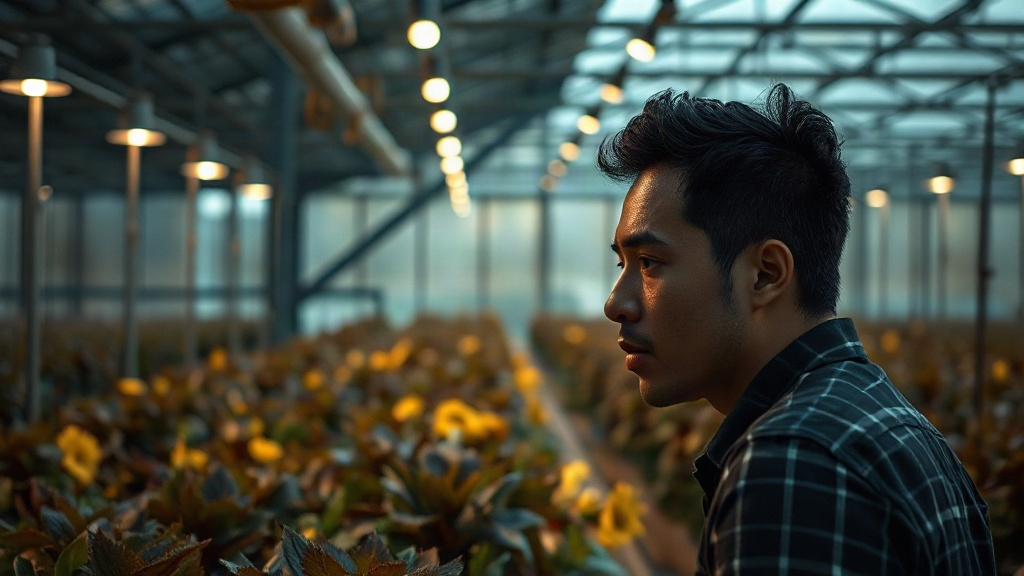
Tom Fernandez has spent 25 years at Michigan State University's Department of Horticulture studying how greenhouse and nursery growers manage water. His own field work shows that watering to a plant's daily use cuts irrigation by 30 to 80 percent, depending on species. The problem he is now attacking is what happens to the water that does run off. The EPA estimates that about half a million tons of pesticides, 12 million tons of nitrogen and 4 million tons of phosphorus fertilizer are applied to crops each year, and a share of that leaves the field and the greenhouse in irrigation return water.

The American Floral Endowment has funded Fernandez's team to test a low-cost answer: woodchips. A woodchip bioreactor is a tank filled with chips through which water passes. The wood gives beneficial microbes a surface to colonize and a carbon source to feed on, and the chips physically bind some contaminants. Woodchip systems have already been used in agriculture to remove nitrate from drainage water. By December 10, 2024, the team was presenting at the Great Lakes Expo on systems that treat more than 25,000 gallons a day, with the 600-gallon unit's tank and chip cost under $1,000.
The bioreactor that matters most ran in an actual production setting. A 1,136-liter unit operated for 126 days in a commercial greenhouse at a 25-minute retention time, according to a paper in ACS ES&T Water. The team also tested a two-stage configuration, a non-aerated bioreactor followed by an aerated one, at 30- and 60-minute retention times. Those results appear in an Acta Horticulturae paper dated October 1, 2026.

The 25-minute retention time is the number that changes the math
The headline figure is nitrogen recovery. At 30 minutes, total nitrogen recycling reached 91.1 percent, plus or minus 11.5 points. At 60 minutes it was 81.5 percent, plus or minus 20.0. The two ranges overlap substantially once the error bars are counted, so the 91 percent is the least important number in the paper.
Pesticide removal is where the tradeoff bites. Dinotefuran removal ranged from 12.0 to 24.3 percent at 30 minutes and from 0.9 to 100 percent at 60 minutes. Cyazofamid ranged from 6.0 to 100 percent at 30 minutes and from 24.5 to 100 percent at 60 minutes. Longer residence generally removed more pesticide, and the spread is wide. Phosphate-phosphorus was completely recycled in both systems.
For a grower, the arithmetic turns on the 25-minute figure. A treatment train that needs an hour of residence means a larger vessel, more pumping and more floor space. A unit that keeps up with the flow of a working irrigation loop can be bolted onto existing production. Speed is what makes this a capital item rather than a research curiosity.
How the non-aerated and aerated pair works
Water enters the first tank, where oxygen stays low. Dissolved oxygen measured 2.42 milligrams per liter in the non-aerated stage at 30 minutes and 2.49 at 60 minutes. That low-oxygen environment favors the microbial processes that break down nitrate and some pesticides. The water then moves into a continuously aerated tank, where dissolved oxygen reached 6.7 and 7.0 milligrams per liter, and the second stage works under different chemistry.
The footprint is small. Taller tanks scale treatment volume without much extra floor space. The Great Lakes Expo materials put the 300-gallon unit at more than 15,000 gallons a day and the 600-gallon unit at more than 25,000. The woodchips can last up to 15 years and can be topped up or replaced.
What the papers show, and the replication gap
The data are peer-reviewed and drawn from a live commercial greenhouse. The Acta Horticulturae paper was presented at the XI International Symposium on Irrigation of Horticultural Crops, and the ACS paper lists funding from the Michigan Department of Agriculture and Rural Development, Project GREEEN, and two grower associations.
What is missing is independent replication. Every result comes from the same group working with the same systems, so this is single-lab data. The pesticide ranges are too wide to serve as a performance guarantee. A grower who installs one of these units is buying a compliance hedge on that data, and the bet is defensible only if the grower treats it that way.
Why regulators and vendors, not scientists, decide the outcome
The science will not drive adoption by itself. Permits and purchase decisions will. A bioreactor priced like a holding tank changes the buy-or-build question for a mid-size wholesale grower facing nutrient-discharge scrutiny. It turns a waste-disposal cost center into a water-recycling asset, and it moves the decision from an engineering project to a capital line.
The chain runs in three steps. First, a packaged kit with installation and chip-replacement service lets a grower compare one product against another rather than commissioning a custom treatment train. Second, a state agency that cites the MSU data in guidance gives that product a documented basis for permit compliance. Third, the value moves to whoever can guarantee a consistent media specification, meaning the same chip size, density and carbon content batch after batch. That is where the margin sits, and it is where consulting engineers who design bespoke trains for large growers lose the middle of the market.
This argument would be wrong in specific ways. If independent labs fail to reproduce the 25-minute performance, the kit market stalls and growers return to holding-tank practice. If no state agency cites the data within two years, the regulatory hedge is weaker than the vendors claim. If vendors cannot hold a consistent chip specification, the service-contract model fails. Early adopters should watch those three signals.
Who gets undercut when the bioreactor costs about as much as a tank
The mid-size grower gains a cheap option next to the holding tank and loses the excuse that no affordable treatment exists. The tank fabricator and woodchip supplier need a media spec they can warrant, which is a new kind of product obligation. The consulting engineer's custom design is exposed to a standard kit on cost and schedule. The state regulator gains a citable, documented option.
The science is public and the papers are peer-reviewed. The commercial packaging, permit language and service contracts are where the money lands, and those are being written now by people who are not the researchers.
From research curiosity to a line item beside the holding tank
Fernandez spent a quarter century showing growers how to use less water. The woodchip work addresses the water that still leaves the property. What made it buyable was the 25-minute retention time, which fits the flow of a working greenhouse. Once a unit fits the existing plumbing and costs about what a holding tank does, it becomes a purchase order.