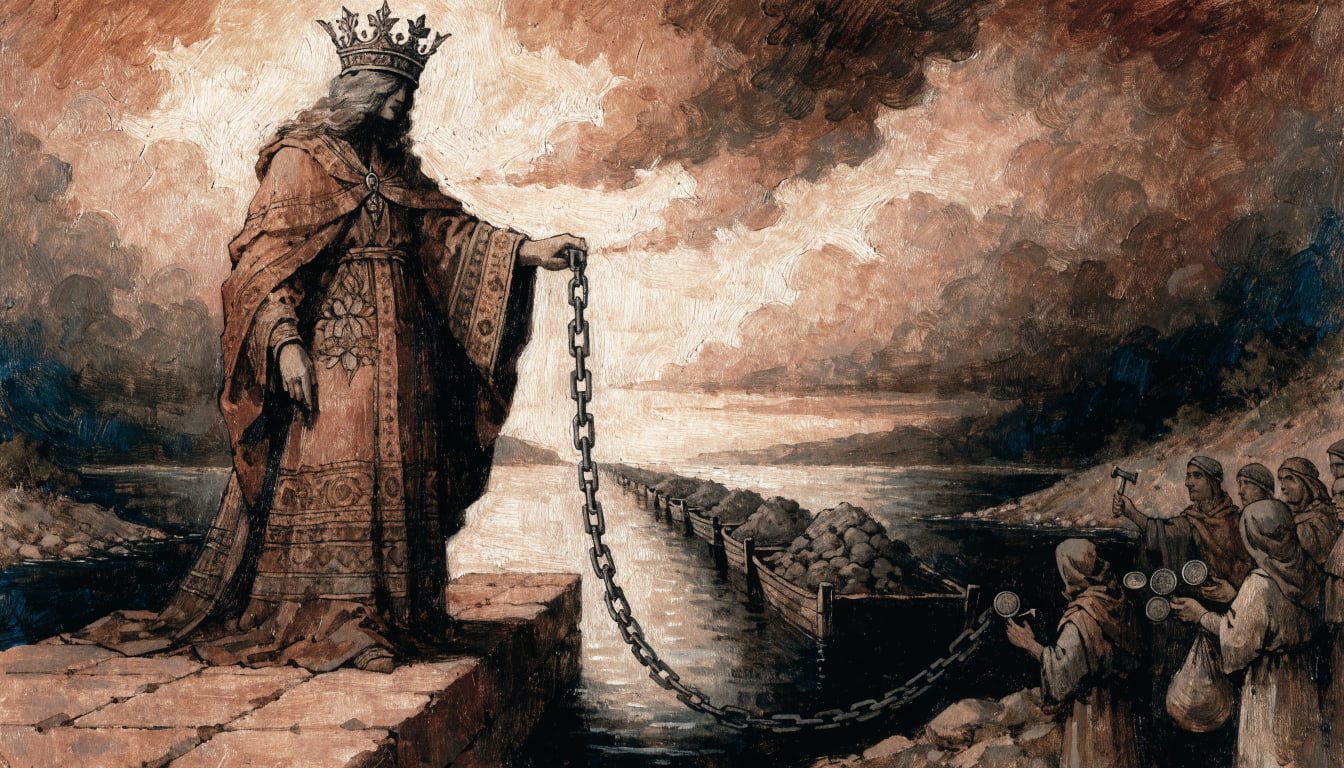
Most of the programmable cryptography conversation stays trapped in the existing financial paradigm: how do we make transactions cheaper, faster, more private? Jason Morton, a mathematician with deep roots in the ZK space, argues this is a failure of imagination. He frames current crypto—tokens, shares, price feeds—as a skeuomorphic port, a digital imitation of clay tablets and paper ledgers. The computational constraints that forced us to collapse human contributions into a single scalar ("token count times last price") have been lifted. We just haven't acted like it. This talk is not a solution pitch. Morton explicitly declines to offer a blueprint. Instead, he provides something rarer: a coherent framework for why the design space is far larger than anyone is currently exploiting, and why the convergence of ZK proofs, consensus algorithms, and LLMs represents a phase shift in what's technically feasible for human economic coordination. He takes the "Martian anthropologist" view—treating money itself as a zero-knowledge proof of value contributed—and uses that lens to ask what happens when you can prove properties about your economic interactions without reducing them to a price. The payoff is a clear articulation of what "maximizing human dignity as an objective function" might actually mean for protocol designers.
Key Takeaways
- Money functions as a crude zero-knowledge proof: it proves you contributed value somewhere without revealing what, when, or to whom—but at the cost of collapsing multidimensional value into a single scalar.
- Current token-based crypto is a skeuomorphic design pattern, porting the "farmer model" of economic organization (stone tablets → paper → databases → blockchains) without questioning whether the model itself still makes sense.
- The computational constraints that forced reductionist accounting are gone. ZK proofs allow selective disclosure of properties without full transparency, enabling economic systems where communities define and evolve their own value functions.
- The convergence of programmable cryptography and LLMs creates a design space for a "secret third thing"—neither capitalism nor communism, but a mode of economic coordination that was technically infeasible before roughly 2026.
- The practical implication for builders: stop optimizing for "token count times last price" as the default value metric. The new primitives allow experiments where value distributions can be intentionally shaped (peaked, flat, or otherwise) rather than inherited from legacy finance.
Who should watch: Protocol architects and ZK application designers who sense that copying ERC-20 patterns onto every coordination problem is a dead end, and want a rigorous conceptual framework for what comes after token-centric design.
Why This Matters
Morton's skeuomorph critique lands at a moment when the gap between ZK's technical maturity and its conceptual poverty is widening. The infrastructure works; the imagination for what to build on it doesn't. This talk is a direct challenge to the reductionist defaults baked into every smart contract platform, and it connects to a pattern we're tracking: the shift from "programmable money" to "programmable value recognition" as the actual frontier.