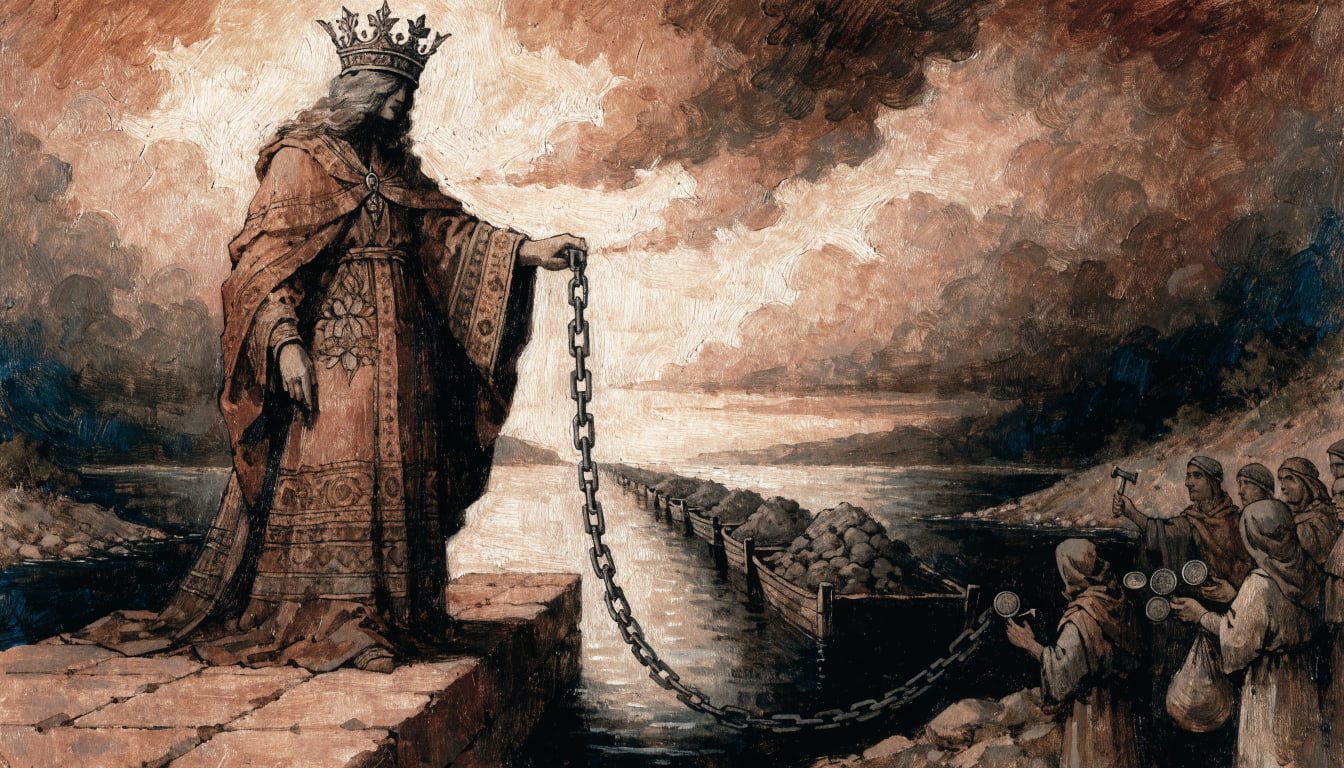
The industry's default mode is optimization within the existing financial paradigm—faster L2s, better lending curves, synthetic exposure to legacy assets. Jason Morton's talk at ETHGlobal's Brussels hackathon refuses to play that game. Instead, he argues we're in the skeuomorphic phase of cryptographic money: we've ported the same double-entry bookkeeping logic from clay tablets to solidity, completely ignoring that the computational constraints have collapsed. Morton, whose academic pedigree includes deep work in category theory and tensor network states before founding Zircuit, takes what he calls a "Martian anthropologist" view. Money, in his reading, is a primitive zero-knowledge proof—an attestation verified without revealing the full graph of social obligations. But now that we have actual ZKPs, consensus, and LLMs, the trade-off surface has shifted. We can decouple value coordination from its legacy financial encoding. The talk offers no products, no roadmaps. It's a crisp, unsentimental provocation aimed at builders who suspect the industry's endgame shouldn't be digital pet rocks but something closer to scaling the "forager mode"—economies where communities dynamically determine what they value without collapsing personhood into a token count times last price.
Key Takeaways
- The economic primitives we're building with blockchain are not novel—they're 5,000-year-old accounting templates (farmer model) ported to a new substrate, complete with the same reduction of value to single scalar quantities.
- Money itself can be framed as a primitive analog zero-knowledge proof: a proof of contribution or claim that gets verified without the verifier needing to see the entire social dependency graph.
- The computational constraints that forced pre-modern and industrial economies into highly financialized, number-reducing systems have now been lifted by programmable cryptography and AI—meaning the Pareto frontier for economic design has genuinely shifted.
- Experimental economic modes that scale community-defined values (rather than globally imposed token counts) are now technically feasible for the first time in human history—not as nostalgia, but as deployed code.
- The goal function for the next economic system should be maximizing human dignity rather than liquidity, and this is an engineering problem, not a political slogan—one where ZKPs and selective disclosure can prevent the habitual reduction of person to price.
Who should watch: ZK engineers and protocol architects who sense current tokenomics is a local maximum and need a rigorous conceptual framework for what programmable cryptography actually changes at the economic design layer.
Why This Matters
Morton's talk is the cleanest articulation of a thesis we're tracking across the ZK stack: the real prize isn't privacy for existing transactions, but the ability to design trust and value systems that were computationally impossible before. It connects directly to questions about on-chain identity and reputation that protocols like JokeRace, Farcaster frames, and anon credential systems are now hitting in production.