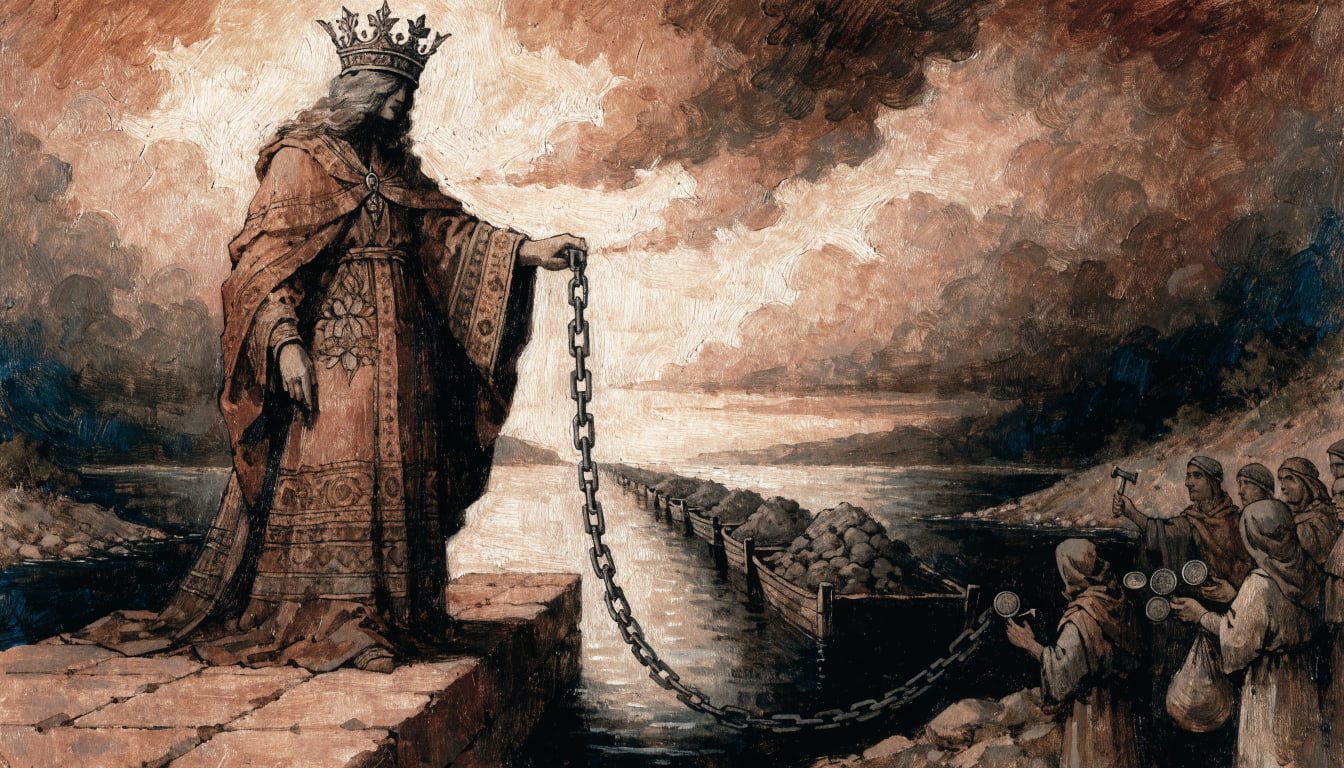
G42's CEO held a single silicon wafer on stage today and made the multi-billion-dollar GPU export policy look obsolete overnight.
 The old gatekeeper rations tiny gears, but behind the crowd a rival forges a monolithic alternative.
Silicon Sovereignty Declared at WGS 2026
On February 5, 2026, at the World Governments Summit in Dubai, a senior member of the Abu Dhabi royal family took the stage to introduce a rectangle of silicon the size of a dinner plate. Lt. General Sheikh Saif bin Zayed Al Nahyan, the UAE’s Deputy Prime Minister and Minister of Interior, presented the reveal as a matter of national infrastructure. Then G42 CEO Peng Xiao demonstrated the chip. “There are over 4 trillion transistors in this chip,” Xiao said, according to Gulf News. “That's 4,000 billion transistors on a single chip. This, together with many other chips, are what we put inside our AI factory to get to work, to produce intelligence.”
 Foreign merchants lose access to the market as the local consortium controls its own source of value.
This was not a product launch. It was a declaration. The chip, co-developed by Abu Dhabi sovereign technology holding G42 and US-based Cerebras Systems, is the third-generation Wafer Scale Engine (WSE-3). Its destination is a 5-gigawatt AI campus in Abu Dhabi, a facility whose power capacity exceeds the total data center footprint of most sovereign states. The first 200-megawatt cluster goes live in 2026, Digital Dubai reported. The rest scales fast.
From GPU Rationing to Wafer-Scale Hegemony
For three years, US export controls on advanced GPUs functioned as a compute rationing system for the Middle East. Nations that could not secure NVIDIA allocation through diplomatic channels were locked out of frontier model training. The marketplace response was predictable: GPUs transshipped through third countries at steep premiums, procurement teams competing against each other for fractional access to silicon engineered in Santa Clara.
G42 and Cerebras already understood the bottleneck. Their Condor Galaxy network, announced in 2023, delivered 4 exaFLOPs of AI compute across 54 million cores in its first phase. The full plan maps nine interconnected supercomputers to 36 exaFLOPs, according to Cerebras. Condor Galaxy 2 is under construction. That infrastructure proved the model works. Today’s reveal proves the model scales.
The logic is now explicit. If the GPU supply chain is a geopolitical chokepoint, the rational response for a sovereign wealth fund is to bypass it entirely. Not to negotiate allocation. Not to build foundries. But to scale the chip itself to the physical limit of a TSMC wafer, eliminating thousands of inter-GPU connections in the process. “If you think of energy as food to feed AI, then the chip is the heart,” Xiao said.
A Monolithic 4 Trillion Transistor Anomaly
Here is what is confirmed about the hardware. The WSE-3 is fabricated on a 5-nanometer TSMC process. It packs 900,000 AI-optimized compute cores onto a single wafer-scale die, delivering 125 petaflops of peak AI performance per CS-3 system. On-chip SRAM sits at 44GB. External memory options range from 1.5 terabytes to 1.2 petabytes. A single CS-3 trains models up to 24 trillion parameters, and up to 2,048 CS-3 systems can cluster together, yielding a peak of 256 exaFLOPs.
What does that transistor count mean in context? NVIDIA’s Blackwell B200 GPU, the chip at the center of the current export restriction battle, holds approximately 208 billion transistors. Apple’s M4 Max, a state-of-the-art consumer processor, holds roughly 28 billion. The WSE-3 packs roughly 20 times more transistors than the Blackwell B200 and approximately 40 times the transistor density of current top-tier GPUs, a figure reported by The Media Line. These numbers are not incremental improvements. They represent a different class of hardware.
The architectural point matters for sovereign workloads. Training a 24-trillion-parameter model across a GPU cluster requires splitting the model across thousands of devices connected by networking fabric. That introduces latency overhead, communication bottlenecks, and failure modes that compound with scale. A wafer-scale chip keeps the model on one piece of silicon with massive on-chip bandwidth. For a nation-state with access to cheap power and no interest in renting compute from a US hyperscaler, the choice is straightforward.
The Fracturing of the Cloud Oligopoly
This is where the story shifts from semiconductor engineering to market structure. The consensus reads today’s announcement as a “world’s largest chip” achievement. That reading privileges engineering novelty over economic consequence. The economic consequence is this: a 5-gigawatt campus powered by wafer-scale engines does not solve a compute shortage. It manufactures a compute overcapacity that makes running frontier AI models economically irrational for anyone without a direct tap into the Abu Dhabi power grid.
Here is what I think that means. Within 12 to 24 months, the hyperscale cloud oligopoly—Amazon Web Services, Microsoft Azure, Google Cloud—will suffer a strategic defeat in the Gulf. Sovereign wealth funds in Saudi Arabia, Qatar, and Kuwait will observe the G42 playbook and recognize that commissioning wafer-scale clusters produces compute at a cost no rental model can match when power is priced at sovereign rates. The region’s most lucrative AI training contracts, the multi-hundred-million-dollar deals to build frontier models from scratch, will migrate to nationally owned infrastructure. The hyperscalers lose the highest-margin segment of the Middle East market, not because their technology is inferior, but because their business model requires a margin structure that sovereign compute does not.
The counterargument is that hyperscalers offer ecosystem lock-in: developers, tooling, inference endpoints, enterprise integration. That argument holds for small and medium workloads. It does not hold for what is happening here. A 5-gigawatt campus housing clusters that train 24-trillion-parameter models is not targeting enterprise SaaS AI. It is targeting the frontier—the models that define what is possible. Whoever trains the largest model sets the terms for inference pricing downstream. If that compute is sovereign, the inference market fragments along geopolitical lines.
Sheikh Saif’s framing supports this reading. He described data protections at the “embassy level,” The Media Line reported, and suggested the UAE’s approach could bring AI access to 40 percent of the global population. That is a jurisdiction play: data governed under UAE law, processed on UAE silicon, powered by UAE energy. A model trained in that environment is not subject to the same export controls, privacy regulations, or commercial terms as a model trained in us-east-1. The fracture line is already drawn.
What to Do About It
Enterprises building on frontier AI should not assume a single global compute market over the next two years. Any company whose training workloads exceed a certain scale ought to model the cost of sovereign wafer-scale compute against hyperscaler GPU rental, factoring in the jurisdictional risks of each. AI labs face a bifurcation of training environments: the US-centric hyperscaler ecosystem with its established toolchains, and sovereign wafer-scale environments with different data jurisdiction rules and lower cost per petaflop at frontier scale.
Talent will follow the clusters. The largest training runs will gravitate toward the cheapest power and the densest silicon. Inference workloads are stickier because latency matters, but even inference will migrate toward training clusters as models grow larger and distillation from frontier models becomes the dominant deployment strategy. The market structure that emerges is not winner-take-all. It is a set of regional compute blocs, each anchored by a sovereign wealth fund that decided the export control regime was a problem to be out-engineered rather than negotiated.
G42’s CEO held up that wafer and made the export policy look obsolete because the policy was written for a world of chiplets and interconnects. The wafer-scale era turns those rules into topological absurdities. You cannot sanction a facility into scarcity when the facility owner builds a bigger chip and plugs it into 5 gigawatts of sovereign power. The transistor count is impressive. The power play is the real announcement.