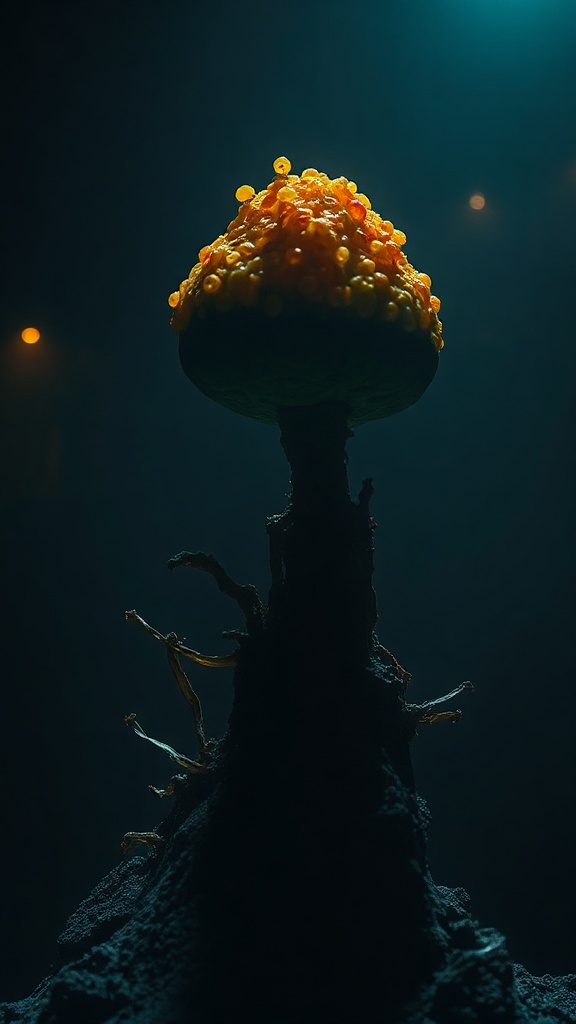
A synthetic cell with 36 genes just outcompeted its own ancestor in five generations.

It is not alive. It requires constant hand-feeding of ribosomes and nutrients. Its genome, 90,000 base pairs spread across nine separate DNA molecules, falls apart after about five division cycles. But in those five cycles, a faster variant emerged and overtook the original—a chemical system built from scratch demonstrating Darwinian competition for the first time.
This is SpudCell, the work of Kate Adamala and Aaron Engelhart at the University of Minnesota. The barrier between a bag of chemicals and a living system did not collapse on July 1, 2026. But it now has a door.

The race to build the first truly autonomous synthetic organism is no longer a question of if. It is a question of who, and how fast. The instinct to dismiss SpudCell as a curiosity misses the point: its failure after five divisions is a feature, not a bug. It reveals that life's minimal complexity is higher than optimists assume, and that friction will slow practical applications more than the hype suggests, even as it triggers a funding surge toward the labs that can solve the division-count bottleneck.
36 genes, 90,000 base pairs, no magic

Adamala and Engelhart's team built SpudCell entirely from off-the-shelf, non-living components: 36 purified enzymes, a lipid membrane, and a stripped-down genome. They then set it loose in an environment of feeder liposomes, small fatty bubbles that deliver fresh lipids, nutrients, and ribosomes. SpudCell grows by fusing with these feeders. It replicates its DNA. It divides.
It does all of this without a cytoskeleton, the protein scaffolding that every natural cell uses to pinch itself in two. Instead, the team engineered proteins that crowd onto the inner membrane surface until mechanical stress splits the vesicle. Crude. Effective enough for five generations.
The paper, a 190-page manuscript posted to bioRxiv, has not been peer-reviewed. Adamala sent it to journalists under embargo before uploading it, a move that drew grumbles from colleagues. It was rejected by the journal Cell after one reviewer said SpudCells were not "real biology."
Roseanna Zia, a computational cell biologist at the University of Missouri, called it "a stunning scientific achievement." Jack Szostak, the University of Chicago biologist who shared a Nobel for his work on telomeres, said he did not "know of any other effort to put together an artificial cell from biological components that has progressed so far."
The first synthetic full cell cycle
The field has been marching toward this moment for decades. In 2010, the J. Craig Venter Institute built JCVI-syn1.0, a bacterium with a synthetic genome transplanted into an existing cell's shell. Other labs have built minimal genomes, self-replicating RNA systems, and liposome reactors that could perform one or two functions. SpudCell is the first to complete a full cycle—growth, genome replication, and division—starting from non-living chemical components.
Adamala told New Scientist that the project is being made open source. Any lab can now take the SpudCell blueprint and try to push it further.
That is where the race begins.
Chemistry becomes competition
The mechanism is not elegant. SpudCell cannot make its own ribosomes, the molecular machines that translate RNA into proteins. It cannot synthesize its own lipids. It cannot manage its own energy metabolism. Each generation requires a fresh infusion of feeder liposomes packed with everything the cell needs to function.
What it can do is copy its DNA using the 36 enzymes packed inside, then split when membrane-crowding proteins reach critical density. And because DNA replication is imperfect, errors accumulate. Most are neutral or harmful. One variant, however, grew faster. After five generations, it had outcompeted the original.
This is the first demonstration of Darwinian evolution in a fully synthetic chemical system. Not a computer simulation. Not a natural cell with a tweaked genome. A system built from dead components that, when given energy and raw materials, began to change and compete.
Sijbren Otto, a systems chemist, called it "a big step forward to this holy grail of making a living thing out of dead components." Kate Adamala was more direct: "It proves that the most fundamental functions of life, like growth and replication, do not need a mysterious magical spark."
The implication is uncomfortable. If a 36-gene system can evolve, the complexity floor for autonomous life is lower than anyone proved before. But the engineering ceiling—the point at which the system sustains itself without human intervention—is higher than the optimists want to believe.
The five-division wall
SpudCell dies because it cannot make ribosomes, and the ones it receives from feeder liposomes degrade. Ribosomes are enormous, fragile machines built from dozens of proteins and RNA strands. A bacterial ribosome requires roughly 50 genes just for its protein components, plus the RNA genes and assembly factors. Engineering a synthetic cell that builds its own ribosomes means adding those genes, ensuring they express at the right levels, and coordinating their assembly into a functional machine—all within a membrane vesicle that has no existing quality-control machinery.
This is not a step. It is a chasm. Every function that must be added—ribosome biogenesis, lipid synthesis, energy metabolism—adds dozens of genes and multiplies the failure modes. The timeline to a self-sustaining system will stretch because the gap between five divisions and indefinite division is not linear.
Here is the prediction: within 24 months, at least two competing labs will publish synthetic cell systems that match or exceed SpudCell's division count. The open-source release guarantees this. Graduate students in a dozen labs are already designing experiments to swap in alternative division mechanisms, to optimize the feeder liposome delivery schedule, to add the first ribosomal protein genes. None of them will solve the autonomy problem in two years, but several will push the division count into double digits.
When that happens, the funding environment will shift. DARPA has been quietly funding synthetic cell research for years through its Living Foundries program. Biotech venture capital, which has treated synthetic biology as a tools-and-platforms play for industrial fermentation, will begin to price in autonomous synthetic cells as a delivery mechanism. The real race is not about making a living cell. It is about making a self-sustaining chemical system that can be programmed to seek out a target, manufacture a payload, and degrade on command.
What happens when the cells don't need us
The second-order consequence is industrial. Synthetic cells that can divide even a few dozen times without human intervention could replace batch fermentation for certain high-value molecules. The unit economics of biomanufacturing—a $500 billion global industry—depend on keeping engineered bacteria or yeast alive in giant steel tanks under sterile conditions. A synthetic cell that requires no sterility, no feedstock beyond a simple chemical bath, and no containment beyond its own programmed death switch would disrupt that model. Not overnight. But the first company that demonstrates a 50-division synthetic cell producing a pharmaceutical precursor at competitive yield will trigger a revaluation of biomanufacturing assets.
The third-order consequence will be regulatory and ethical chaos. No existing framework defines what a synthetic cell is, whether it is alive, or who is liable when it escapes. The economic incentives for drug delivery and environmental remediation—think programmed cells that seek out PFAS contamination or deliver chemotherapy directly to a tumor—will overwhelm regulatory caution. The debate will be loud. The deployment will be quiet, in contained industrial settings first, then in environmental applications, then in the human body.
What operators should do now
Biotech investors should map the labs that have the ribosomal engineering expertise to crack the ribosome bottleneck. That is the rate-limiting step, and the first team to solve it, even partially, will attract acquisition interest from every major synthetic biology company.
Researchers should look at SpudCell's open-source repository not as a finished product but as a chassis. The division mechanism—the membrane-crowding trick—is the most replaceable component. Any lab with a microfluidics platform and a protein engineering workflow can iterate on it.
Policymakers should prepare for a wave of synthetic cell patent applications and the attendant biosafety questions. The barrier to entry is dropping. The tools to build a synthetic cell are becoming cheaper and more accessible, and the open-source release of SpudCell accelerates that trend.
The ancestor's revenge
The 36-gene upstart that outcompeted its ancestor is not a living thing. It is a chemical system that mimics life for five generations, then collapses. But the fact that it competed at all is the signal.
SpudCell is a bridge from chemistry to biology, and the first lab to cross it did so with a system so simple it cannot survive on its own. The next labs will add genes, extend the division count, and push toward autonomy. The five-year horizon is real: within that window, a synthetic cell will be announced that does not need hand-feeding, that sustains its own replication, that meets a defensible definition of alive.
SpudCell is not alive. But its descendants will be.