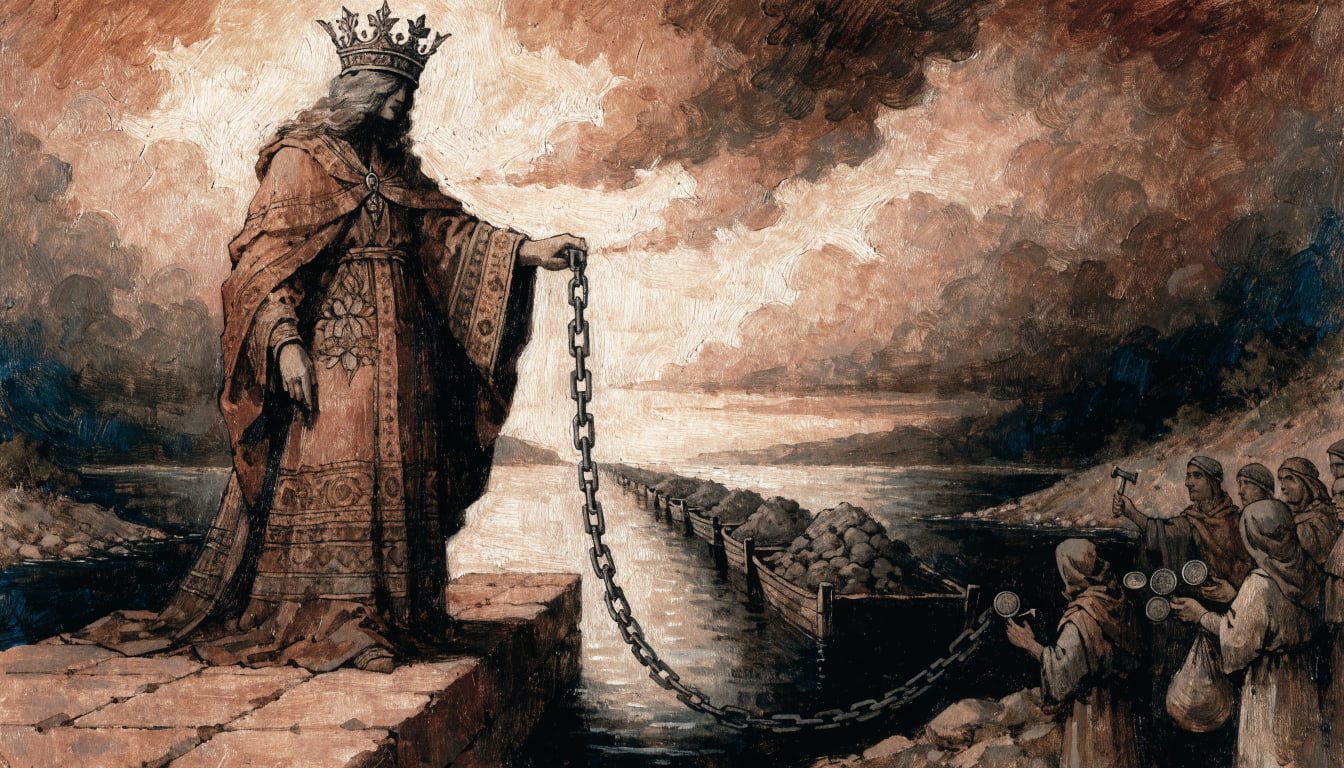

Asian spot LNG prices hit $22 per million British thermal units in July 2026, yet demand is forecast to fall 8 percent, the first contraction in a decade, as buyers flee the chokepoint.
The Strait of Hormuz crisis has done what a decade of supply growth could not: it made global LNG demand shrink. Not because the world ran out of gas. Because a small, violent stretch of water made the cost of moving it unbearable. Iran weaponized a trade artery, and the market’s response was not to find new supply, but to stop buying. The numbers are stark. Exports of LNG through the Strait declined by 95%. QatarEnergy, the world’s largest LNG exporter, declared force majeure in March 2026, removing roughly one-fifth of global supply almost overnight. The combined merchandise exports from Hormuz-dependent economies fell 21% in April. A global commodity system built on just-in-time delivery met a single point of failure, and demand cratered.

The night the Strait went quiet
The shock was instantaneous. On February 27, 2026, 95 vessels per day traversed the Strait of Hormuz. By March 2, that number was four. A US-Israeli military campaign against Iran, launched in late February, triggered Iranian retaliatory strikes on Gulf state infrastructure and shipping. Missiles and drones damaged Qatar’s Ras Laffan complex, hitting 14 LNG trains, ancillary processes, and gas-to-liquids facilities. QatarEnergy’s force majeure notices have since been extended into mid-October 2026. Analysts expect up to 35 million tons of LNG to be lost in 2026.
The first LNG carrier to leave the Strait since July 11 was the QatarEnergy-controlled Al Areesh on July 29. A single ship. Not a reopening. A test.
The calibrated stranglehold
Iran is not trying to win a war. It is trying to extract concessions by making the Strait’s vulnerability painful and permanent. Michael Knights of the Washington Institute described the strategy to Al-Monitor: “Iran, from the beginning, has tried to out-escalate the United States by stretching out its escalation options so that it always has something new to bring every week — a new geography, a new type of weapon, a new type of target.” He added: “Their big advantage is that they can hurt the regional states and the global economy.”
The mechanism is not a physical blockade. It is a constant, credible threat of attack. Every insurer, every shipowner, every offtaker now prices in the probability that a vessel transiting Hormuz becomes a target. That probability will not return to zero. An interim US-Iran agreement was reached in mid-June 2026 aiming to reopen the Strait. But Iran has already signaled that no maritime chokepoint is off limits. The threat portfolio has expanded. The IEA assumes the Strait fully reopens in Q3 2026, with undamaged facilities restored by early Q4. That is optimistic. Infrastructure damage at Ras Laffan is severe. Iran’s governance demands remain unresolved. A partial reopening dragging into Q1 2027 is the more likely baseline.
This is structural. Buyers halted purchases not just because supply was blocked, but because sourcing from the Gulf corridor became a permanent liability. The “chokepoint premium” is now a fixed cost in every LNG contract negotiation, and it will not be competed away.
The 24-month reordering
The crisis has permanently reshuffled investment priorities. The chairman and CEO of Gas Strategies told The National: “The next phase of LNG will not be defined by who builds capacity fastest. It will be defined by who manages uncertainty best.”
That uncertainty has a price, and it is already redirecting capital. Within 12 to 18 months, the flow of final investment decisions will tilt decisively away from Gulf mega-projects toward diversified Atlantic Basin and East African production. The US and Mozambique are the primary beneficiaries. The US government authorized the Plaquemines LNG plant to increase exports by 13% (4.6 bcm/year) in March 2026, an acceleration that signals where policy and capital are heading. US Gulf Coast export capacity additions will pull forward by two to three years.
Contract terms are being rewritten. By late 2027, at least 15% of global LNG trade will be renegotiated under clauses that penalize transit through high-risk maritime corridors. The “Hormuz Clause” will become standard: a pricing mechanism that bakes in destination flexibility and applies a premium for supply that avoids chokepoints. Buyers will pay more for certainty. Sellers who can guarantee delivery without a Strait transit will capture that premium.
Qatar will recover. Its resource base is too vast and too cheap to ignore. But its market share will be structurally lower by 5 to 8 percent versus pre-crisis projections. The country’s expansion plans, once the anchor of global LNG supply growth, will face slower sanctioning and higher financing costs. The risk is now priced in.
The biggest losers are price-sensitive Asian buyers. India and Pakistan have already imposed industrial gas use curbs as spot prices hit $22/MMBtu. These countries lack the balance sheets to compete with European and Northeast Asian offtakers for non-Hormuz supply. They face permanent premium pricing and reduced access to spot cargoes. The likely outcome: coal backsliding or an accelerated, costly push into domestic gas development. Neither is fast.
The winners are clear. Diversified LNG producers outside the Middle East capture market share and margin. Insurance markets gain a new, durable class of geopolitical risk premiums. Shipowners with fleets capable of rerouting around chokepoints see their vessels revalued upward. And the Atlantic Basin, from the US Gulf Coast to Mozambique’s Coral South FLNG, becomes the new center of gravity for marginal LNG supply.
Operator’s hedging guide
Do not bet on a quick return to normal. Begin auditing your supply contracts now for chokepoint exposure. The cost of energy from the Gulf has structurally increased. The IEA’s Q3 2026 reopening assumption is a planning scenario, not a forecast you should underwrite.
Plan for a world where Asian spot prices remain elevated and the Hormuz clause becomes standard in new sale and purchase agreements. The next wave of US LNG export capacity is your only hedge. Lock in offtake from projects that can guarantee delivery without a Strait transit. The premium you pay today will look cheap against the spot market in 2027.
The cost of the unforeseen has a new name
The $22 price and the 8% demand contraction are not a spike. They are the new baseline. The Strait of Hormuz is the Strait of Malacca, the Panama Canal, and the Turkish Straits rolled into one: one quarter of global seaborne oil trade and a third of globally traded urea pass through it. Its vulnerability is now structural, and the market is only starting to price the true cost of a single point of failure.
The Al Areesh transited out of Hormuz on July 29. That was not a return to normal. It was an exception that proves the shift. The era of chokepoint-secure LNG is over. The battle for the Strait is paused. The war for its replacement has just begun.