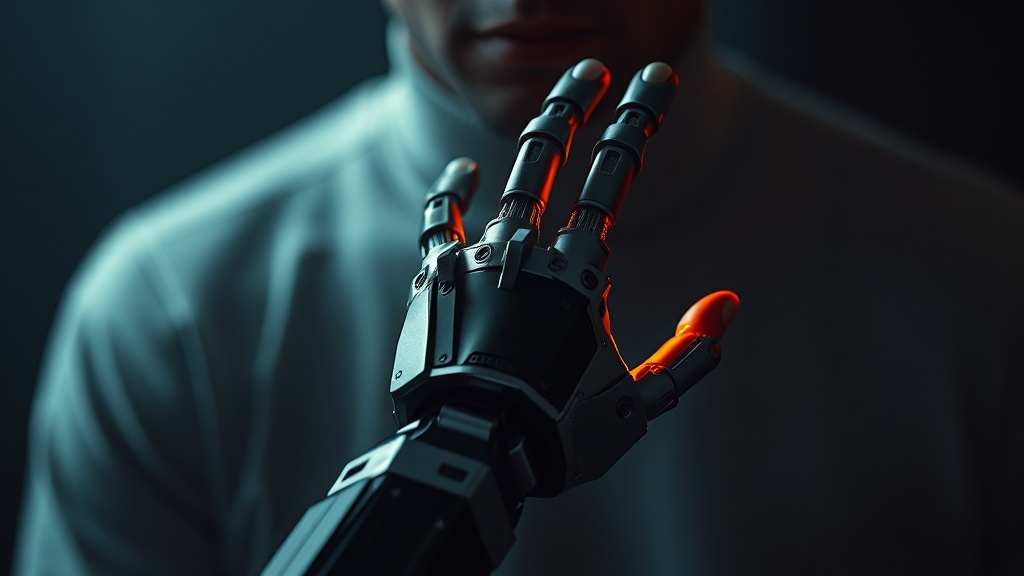
Two amputees controlled a bionic hand for 300 days without anyone touching the control algorithm.

The study, published March 4, 2020 in Science Translational Medicine, demonstrated that a regenerative peripheral nerve interface (RPNI) could serve as a biologically stable amplifier of motor signals in upper limb amputees. That alone would have been a milestone. But the durability data that followed, published in the Journal of Neural Engineering, is what should keep prosthetic executives up at night.
Participant 2 maintained real-time prosthetic performance above 94% accuracy for 604 days without recalibration. On a real-world coffee-making task, the same participant hit 99% accuracy for 611 days. No clinic visits. No algorithm retraining. No degradation.

Signal quality, measured as signal-to-noise ratio, stayed above 15 for 276 days in Participant 1 and for 1,054 days in Participant 2. That is nearly three years of clean signal. The coffee task accuracy made a nice headline. The durability data changes the economics of an entire industry.
The muscle graft that outlasts the algorithm

The RPNI is a surgical construct, not a software patch. Surgeons take a small autologous free muscle graft, wrap it around the severed end of a peripheral nerve, and let the nerve regenerate into the muscle. The muscle becomes a biological amplifier, converting faint neural signals into robust electromyography (EMG) outputs that implanted electrodes can read.
In the two transradial amputees studied, the setup was extensive. Participant 1 had intramuscular bipolar EMG electrodes placed in 3 previously created RPNIs (1 median, 2 ulnar nerve) and 5 residual muscles. Participant 2 received electrodes at the time of RPNI creation, with 4 median and 1 radial nerve RPNIs plus 7 residual muscles wired for signal capture.
Ultrasound assessments confirmed functional reinnervation. When the participants thought about flexing phantom fingers, the RPNIs contracted visibly. The nerve had grown into the muscle and was firing on command.
This is the opposite of the traditional myoelectric approach. Surface electrodes sit on the skin, reading muscle activity through layers of tissue, sweat, and shifting socket pressure. Signal quality degrades with socket fit changes, electrode displacement, and skin impedance fluctuations. The software compensates with frequent recalibration sessions, pattern recognition retraining, and algorithm adjustments. The biological interface is the bottleneck, and the industry has spent decades building better software to work around it.
The RPNI team, funded by NIH grant R01 NS105132, removed the bottleneck.
Why signal stability is the economic unlock
The prosthetic industry has been trapped in a cycle of incrementalism. Better sockets. Better pattern recognition. Better machine learning classifiers. But the fundamental problem was never the algorithm. It was the signal source.
Surface EMG is inherently unstable. You can train a classifier to 95% accuracy in the lab on Tuesday and watch it fall to 70% on Thursday because the user put on a different shirt or the humidity changed. RPNI flips the equation. The signal is stable for years. The algorithm becomes the afterthought.
This has a direct line to money. Current advanced myoelectric systems require regular clinic visits for recalibration, socket adjustments, and retraining. Each visit costs the payer. Each visit costs the patient time and frustration. The total cost of ownership for a bionic hand includes not just the device but the clinical labor to keep it functional.
RPNI's durability data collapses that recurring cost. The upfront surgery is not trivial, but the downstream maintenance burden approaches zero for years at a time. Insurers have been reluctant to cover advanced bionics precisely because the maintenance costs are unpredictable and ongoing. A stable implant changes the actuarial calculation. It becomes a capital expense with a predictable depreciation curve rather than an open-ended service liability.
The coming recalibration of the prosthetic industry
Here is the chain of consequence that the durability data sets in motion.
The R&D budget shifts. Prosthetic manufacturers have allocated significant engineering resources to pattern recognition and adaptive algorithms. If the signal is stable for 600-plus days without recalibration, the marginal value of a better classifier approaches zero. The differentiation moves to the implant: the electrode design, the surgical procedure, the hermetic packaging, the wireless telemetry. Companies that have spent a decade building software teams will need hardware and clinical teams instead.
The reimbursement landscape restructures. CMS and private insurers now have peer-reviewed durability data showing a neural interface that works for years without maintenance. That is the evidence threshold they have been waiting for. Within 12 to 24 months, expect CMS to issue a draft coverage memo for implantable neural interface devices, explicitly citing these signal stability and accuracy figures as evidence of clinical utility. Once CMS moves, private payers follow within a quarter.
A surgical bottleneck emerges and then resolves. RPNI implantation requires a surgeon trained in the technique. There are not enough of them today. But the procedure uses autologous muscle grafts, no exotic materials, and standard microsurgical techniques. The barrier is training, not technology. Prosthetic clinics will begin building referral relationships with hand surgeons and peripheral nerve specialists. The clinics that move first will capture the early-adopter patient population.
The addressable market expands. The same RPNI technique works for lower-limb amputees. The same principle of biological signal amplification could apply to sensory feedback, closing the loop on proprioception and touch. A platform technology that starts in transradial amputees does not stay there.
The specific, falsifiable prediction: Within 12 to 24 months, at least one major prosthetic manufacturer will announce a commercial RPNI-based system targeting transradial amputees. CMS will issue a draft coverage memo for implantable neural interface devices within the same window. If neither happens by March 2027, the thesis is wrong.
What to do now
Prosthetic clinic directors: identify and build relationships with surgical teams capable of RPNI implantation. The referral pipeline takes time to establish, and the early adopters will come through those channels.
Manufacturers: evaluate whether to license the RPNI technique or develop in-house electrode systems designed for intramuscular implantation. The software-centric product roadmap is now a liability. The hardware and clinical workflow is the moat.
Investors: map the landscape of implantable neural interface startups, with particular attention to those solving the wireless telemetry and hermetic packaging problems. The clinical data exists. The reimbursement pathway is clearing. The missing piece is the product engineering.
Payers: begin modeling the total cost of ownership comparison between conventional myoelectric systems and implantable RPNI-based systems. The durability data suggests the implant is the cheaper option over any reasonable time horizon. Getting ahead of the coverage decision avoids the reactive scramble when the first commercial system lands.
Biology beats software
The two amputees did not just control a hand for 300 days without recalibration. They proved that a small piece of their own muscle, grafted onto a severed nerve, could produce a cleaner and more durable control signal than any algorithm the prosthetic industry has ever shipped.
The industry spent decades trying to make software smart enough to interpret a noisy signal. The RPNI team made the signal so clean that the software barely matters.
A bionic limb that works for years without a clinic visit is not a clinical novelty. It is a consumer product with a defensible reimbursement code and a predictable cost curve. The prosthetic industry's future is not in better algorithms. It is in better biology.