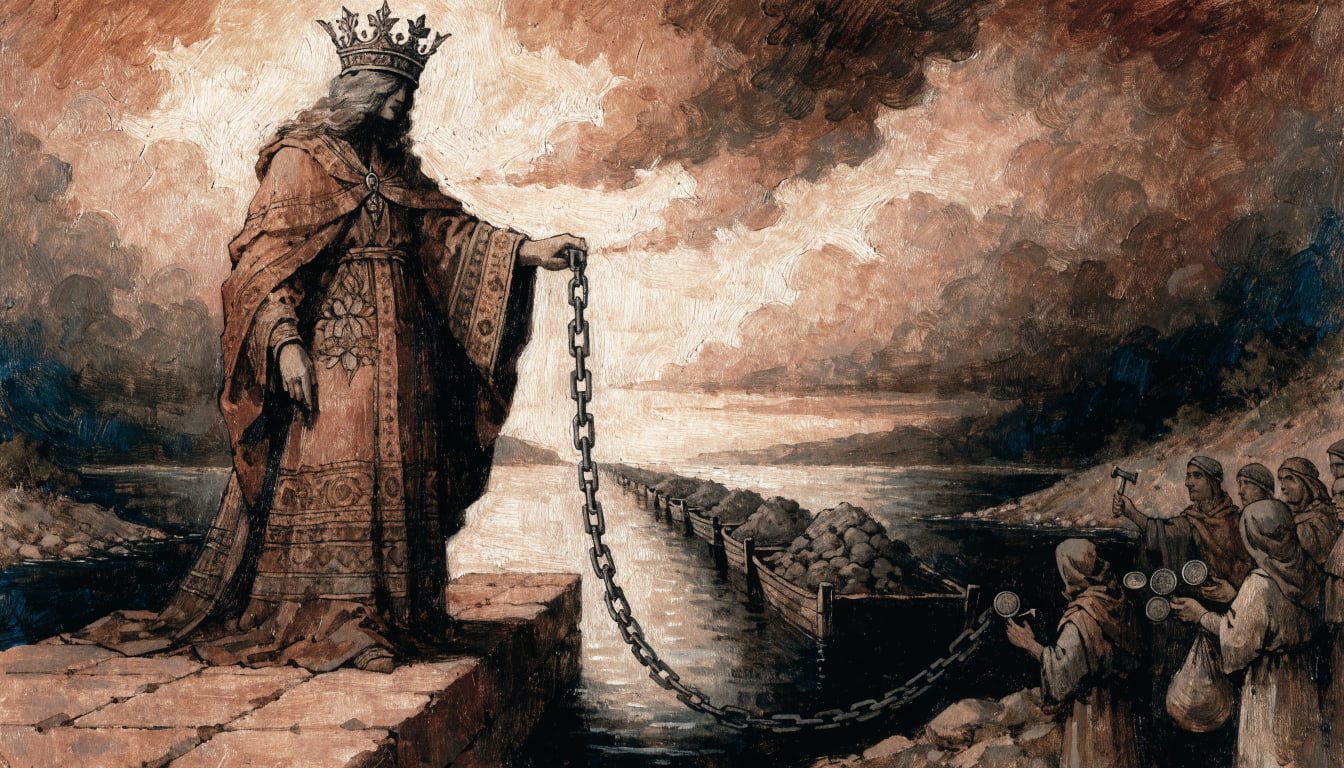
Six Indian oil tankers just paid for safe passage through Hormuz without ever touching a dollar.

The transaction, a coordinated cluster inbound transit on May 18, 2026, wasn't a one-off barter deal or a black-market workaround. It was the operational debut of a new state-administered toll booth that is physically breaking the petrodollar's monopoly at the world's most critical energy chokepoint. The Persian Gulf Strait Authority (PGSA) went live that day, enforcing a de facto passage fee system that accepts payment in Chinese yuan via accounts at Kunlun Bank, outside the SWIFT network, with reported per-transit payments reaching up to $2 million.
This is a structural fracture. Within 18 months, the global oil market will split into two currency blocs. The Petroyuan will not replace the Petrodollar globally, but it will carve out a durable, parallel sphere encompassing Iranian, and likely some Iraqi and Venezuelan, crude sales to Asian buyers. The real casualty is the unified global benchmark. Brent crude, hovering at $91-92 per barrel as of May 31, will lose its status as the single reference price for world oil. A two-tier market is emerging where yuan-settled barrels trade at a persistent discount to dollar-settled barrels, permanently altering hedging, refining, and maritime insurance.

The Petrodollar’s Last Stand at the Chokepoint
The system now under physical assault was built in the 1970s. The 1971 Nixon Shock unpegged the dollar from gold, and Henry Kissinger’s 1974 deal with Saudi Arabia and OPEC re-anchored it to oil. The arrangement was simple: the US guaranteed military protection for the Gulf states, and they priced their crude exclusively in dollars. For half a century, that deal held. The Strait of Hormuz, handling over 20% of global petroleum consumption with roughly 17.8 million barrels per day of throughput, functioned as the dollar's most powerful enforcement mechanism.
The current crisis sequence broke that enforcement. On February 28, 2026, US-Israeli attacks on Iran began. Iran retaliated by closing the Strait to ships from most countries. The US responded on April 13 with a naval blockade of Iranian ports, crushing Tehran's conventional export capacity. Iranian crude exports collapsed to their lowest level in at least six years. The US Treasury’s Office of Foreign Assets Control (OFAC) piled on with Operation Economic Fury, designating 28 vessels in five weeks, including 19 in a single action. In a parallel enforcement campaign, the US seized three Iran-linked tankers, the latest being the VLCC SKYWAVE on May 19.
It looked like a successful economic siege. The consensus framed it as a straightforward geopolitical defeat for Iran. That reading misses what Tehran did while the US Navy was fixated on the blockade.
The Mechanism: A Yuan Toll Booth at the World's Jugular Vein
The PGSA is a toll booth, not a military posture. It charges a fee, estimated at $0.50 to $1.20 per barrel of cargo, for transit through the Strait. Payment is negotiated and settled in Chinese yuan through Kunlun Bank, the Chinese institution that has historically processed Iran-China transactions outside the SWIFT system. The system also employs a broader mechanism of informal cryptocurrency transfers, reportedly Bitcoin, to IRGC-linked wallets.
The toll regime creates a two-tier access system. India, Iraq, and Pakistan secured bilateral safe-passage arrangements outside the formal fee structure, which explains the six India-flagged vessels transiting as a coordinated cluster on May 18. Chinese-linked and UAE-managed gray fleet operators absorb the toll directly. Western-flagged vessels have no viable transit option.
This is not a sign of Iranian strength. It is a fire sale of Iran's sole remaining geographic asset. Its conventional export capacity has been crushed by the US blockade. Tehran is monetizing the Strait's chokepoint geography to secure a financial lifeline from Beijing. The strategic winner is China, which gains de facto operational control over Hormuz transit prioritization without firing a shot, while the US Navy enforces a blockade that simultaneously strangles Iran and pushes it deeper into Beijing's financial architecture.
Iran has also activated the Kuh Mubarak offshore loading buoy on its Gulf of Oman coast, a terminal that exported zero barrels through November 2025. Over five months, it lifted approximately 6.9 million barrels of Iranian Heavy crude, with every single barrel destined for China. This parallel export node bypasses the Strait entirely, creating a dedicated Iran-China crude pipeline that never touches dollar-denominated waters.
The Fracturing of a Unified Oil Market
Here is the prediction. The Petroyuan will not replace the Petrodollar. What it will do is carve out a permanent, parallel sphere. The real casualty is the global benchmark.
A two-tier market is now inevitable. Yuan-settled barrels, Iranian crude first and eventually Iraqi and Venezuelan volumes, will trade at a persistent discount to dollar-settled Brent. The discount is not a market inefficiency to be arbitraged away. It is a structural risk premium priced into the currency and the sanction exposure. A refiner in India or China will have to choose between a dollar barrel priced against Brent and a yuan barrel priced against whatever shadow benchmark emerges from the PGSA system. Those two prices will not converge.
The cascading consequences are immediate. Global hedging strategies split. A refiner optimizing for Brent no longer has a pure view on the physical crude market when a growing share of physical barrels settles in a different currency. Maritime insurance markets fracture along geopolitical lines, because a vessel's flag and ownership structure now determines its right of passage through Hormuz. A Greek-owned, Liberian-flagged tanker carrying Iraqi crude to a European refinery operates in a different legal and financial universe than a Chinese-managed, Cameroon-flagged tanker carrying Iranian crude to a Chinese independent refiner. The Brent price at $91-92 is no longer a single source of truth. It is the price for one half of the market.
What This Means for Operators
For traders, the end of Brent as a pure global hedge is a portfolio restructuring event. The basis risk between yuan-settled and dollar-settled barrels will require new contracts, new benchmarks, and new clearing mechanisms.
For refiners, feedstock sourcing becomes a geopolitical choice with a direct currency P&L. A refiner that commits to yuan-settled Iranian crude gains a cost advantage but accepts exposure to a Chinese banking channel and a sanctioned supply chain. A refiner that sticks to dollar-settled Brent-linked crude pays a premium for financial cleanliness.
For insurers and shippers, the vessel is now the sanction. The flag, the beneficial owner, the cargo origin, and the payment currency together determine whether a ship transits Hormuz or waits in a holding queue. Commercial throughput through the Strait held at 38% of pre-disruption levels as of May 18. The remaining 62% is not just delayed. It is being re-routed through a new financial architecture.
The six Indian tankers that transited on May 18 are not an anomaly. They are the prototype of the new order. The world of seamless global energy trade, where a single benchmark priced in a single currency cleared through a single financial system, ended the day the PGSA went live. The Strait of Hormuz is no longer just the jugular vein of the global economy. It is now the toll booth where that economy splits in two.