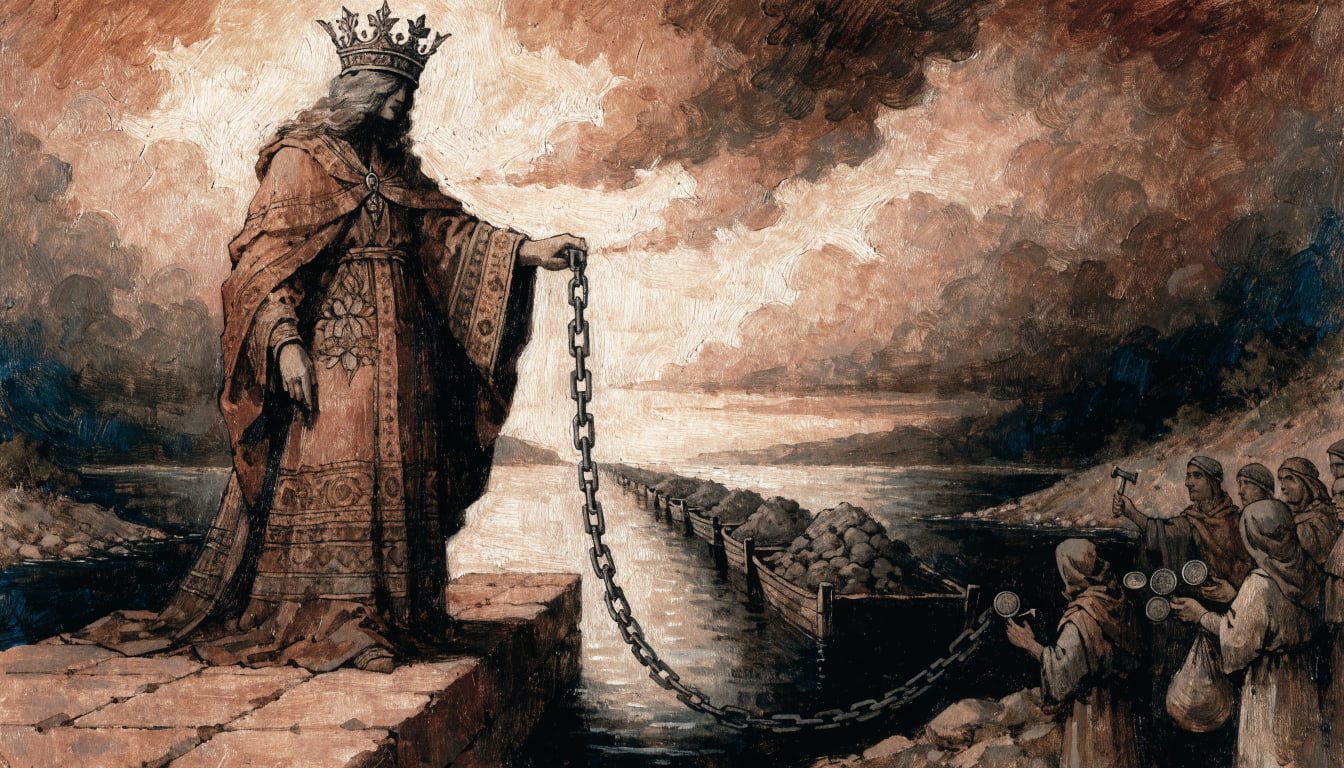
Ethereum's core development ecosystem needs $30 million annually to survive. It has less than nine months to find it.

The clock started ticking in April 2026 when the Client Incentive Program expired. It accelerated on June 18 when Hsiao-Wei Wang, co-executive director of the Ethereum Foundation, announced her resignation. That same day, former EF contributor Trent Van Epps published a detailed warning: the network's protocol development is heading for a funding wall, and the mechanisms that used to prevent that no longer exist.
Van Epps spent five years inside the Foundation coordinating core development and building Protocol Guild. He left in April 2026. His post-mortem, titled "Succession After Subtraction," lays out a crisis that is not accidental. It is the intended consequence of a seven-year organizational philosophy now colliding with financial reality.

The Doctrine That Built the Gap
Over the last seven years, the Ethereum Foundation management and Board developed an organizational philosophy it calls "Subtraction." The EF Mandate from March 2026 states it plainly: "Our goal is to reduce the Foundation's relative influence over time. This is not retreat or sabotage. Subtraction is rather a process of ensuring Ethereum's maturity, robust enough to outgrow and outlast us."

The mechanism for this reduction is a treasury policy announced in June 2025 that commits the Foundation to cutting annual spending from 15% of its assets down to a 5% endowment-level baseline by 2030. The glide path is aggressive. The consequences are already visible.
Nineteen people have been laid off or departed the Ethereum Foundation so far in 2026. Tomasz Stańczak stepped down as co-executive director in February. Wang's departure leaves Bastian Aue as the sole executive director, a role he had been holding in an interim capacity since Stańczak left. Wang framed her exit as a personal decision after a sabbatical, not a dispute. The timing still lands hard.
Subtraction was designed to force the ecosystem to self-organize. The question now is whether it subtracted too much, too fast, from the one function that cannot fail.
The $30 Million Clock
The math is not complicated. Annual funding of approximately $30 million is required to support Ethereum's core development ecosystem. That covers the engineers maintaining execution and consensus clients, the researchers working on protocol upgrades, and the coordination layer that keeps a multi-client network from fragmenting.
The Client Incentive Program, which provided direct funding to client teams, expired in April 2026. The Foundation's treasury policy is simultaneously reducing the grants that many of those same teams relied on. Project Odin, a structured support program announced in February 2026, is designed to help a small set of strategic grantees build pathways to sustainability over a two-year horizon. It is not a replacement for permanent funding. It is a bridge, and the far side of that bridge is not yet built.
Van Epps, citing recent conversations with core development contributors, warned that Ethereum risks entering a "slow-burning funding crisis." Slow-burning is the operative word. The damage will not announce itself with a crash. It will show up as maintenance slowdowns, unfixed bugs, and client teams quietly going dark.
Here is what is confirmed: the funding gap is real, the timeline is three to nine months, and the Foundation has explicitly stated it will not fill it.
Here is what that means.
The Consolidation Cascade
Ethereum's security model depends on client diversity. If one execution client has a critical bug, the network survives because other clients process transactions differently. That redundancy is not a nice-to-have. It is the architecture that prevents a single software fault from halting the entire chain.
Client diversity costs money. Execution clients like Nethermind, Besu, and Erigon require full-time maintainers. Those maintainers require salaries. When the Client Incentive Program expired and Foundation grants began shrinking, the economics of maintaining a minority client stopped making sense for teams without alternative revenue.
The mechanism is straightforward. A client team loses funding. Maintenance slows. Users and stakers migrate to the dominant client to reduce their own risk. The minority client's user base shrinks further. The team disbands. The network's client diversity degrades by one.
This is not a hypothetical. The funding gap is large enough and the timeline short enough that at least two major execution clients are likely to cease maintenance within 12 to 18 months. When that happens, the network's failure tolerance drops. A bug in the dominant client becomes a systemic risk rather than an isolated incident.
The Ethereum Foundation's Subtraction philosophy bets that the ecosystem will self-organize funding before that point. It is a calculated risk. The calculation may be wrong.
The Fork Over Fees
This is where the crisis leaves the realm of grant applications and enters governance. The chain of causation is direct, and each link is load-bearing.
First, the funding gap forces a visible failure. Within 12 to 18 months, at least one major execution client will announce it can no longer maintain production-grade releases. The announcement will not be a surprise to insiders, but it will shock the broader community. Stakers running that client will have weeks, not months, to migrate. Some will get slashed during the scramble because rushed migrations produce mistakes.
Second, the failure concentrates risk. As minority clients disappear, the dominant execution client's market share among validators will cross 66%. At that threshold, a supermajority bug can finalize an invalid chain. The network's theoretical fault tolerance becomes theoretical in the worst sense—it exists on paper, not in practice. Core developers will begin warning publicly that Ethereum's security assumptions no longer hold.
Third, the concentration triggers a governance crisis. A contentious Ethereum Improvement Proposal will emerge. The proposal will be simple: redirect a portion of transaction fees—currently burned or paid to validators—to fund core development in perpetuity. The mechanism would likely repurpose a fraction of the base fee that EIP-1559 currently burns, routing it to a protocol-level funding contract managed by a DAO or a multisig of client teams.
The community will split into two factions.
The "pay-for-security" camp will argue that $30 million annually is a rounding error compared to the network's economic value, that protocol security is a public good the market has failed to fund, and that a small, predictable fee redirection is the only credible mechanism to prevent client consolidation. They will point to the dead clients as proof that voluntary funding failed.
The "keep-it-free" camp will argue that redirecting fees breaks a fundamental social contract, that it enriches developers at the expense of ETH holders, and that it sets a precedent for rent-seeking that will escalate over time. They will frame the proposal as a tax imposed by a technical elite that failed to build sustainable business models.
Both sides will have legitimate arguments. Neither will compromise easily. The debate will play out across Ethereum Improvement Proposal forums, All Core Devs calls, and eventually social media, where the temperature will rise faster than the reasoning.
A hard fork is a real possibility. If the fee redirection proposal passes but a significant minority rejects it, the network could split. One chain funds core development through protocol-level fees. The other does not. Both claim to be Ethereum. Exchanges and stablecoin issuers are forced to choose. The market decides which survives.
That scenario sounds extreme. It is also the logical endpoint of a funding model that relied on a single foundation's generosity for seven years and is now withdrawing that generosity on a fixed schedule with no replacement in place. The Foundation's Subtraction philosophy was meant to ensure Ethereum's maturity. It may instead force a governance crisis that tests whether the network can make hard decisions without splintering.
What would falsify this prediction? A credible, multi-year funding vehicle emerging from the private sector within the next six months—something like a consortium of major DeFi protocols committing a percentage of revenue to a client funding DAO. If that materializes before the first client death, the governance crisis defuses. If it does not, the fork scenario becomes the base case.
What Stakers and Developers Should Do Now
For stakers, the immediate risk is slashing. A bug in a dying client that is no longer receiving timely patches can cause validators running that client to be penalized. Diversify your client setup now. Do not wait for a maintenance announcement that may never come. If you are running a minority client, have a migration plan ready.
For developers building on Ethereum, the risk is more structural. If client diversity degrades to a single dominant implementation, the protocol becomes less resilient to bugs and more vulnerable to capture. The network you are building on becomes less credible as neutral infrastructure.
The governance battle over fee redirection will affect everyone. If you hold ETH, stake, or build on Ethereum, you have a stake in how this resolves. Pay attention to the Ethereum Improvement Proposal process. The proposals that will define this fight are likely being drafted right now.
The Subtraction Reckoning
Ethereum's core development ecosystem needs $30 million annually to survive. It has less than nine months to find it. The Ethereum Foundation has been clear: it will not provide it.
That is not a failure of planning. It is the plan. Subtraction was designed to force the ecosystem to grow up. The question is whether the ecosystem can grow up fast enough to prevent the network's security model from degrading before alternative funding mechanisms mature.
Van Epps called it a slow-burning funding crisis. Slow-burning crises have a way of becoming sudden emergencies when the fire reaches something flammable. The Client Incentive Program is gone. The Foundation's spending is shrinking. The client teams are making their own calculations about how long they can last.
Nine months is not a long time. It is barely enough to draft a proposal, build consensus, and implement a solution. The clock is running. The Foundation's subtraction is almost complete. What comes next depends on whether the community can add faster than the Foundation subtracts.