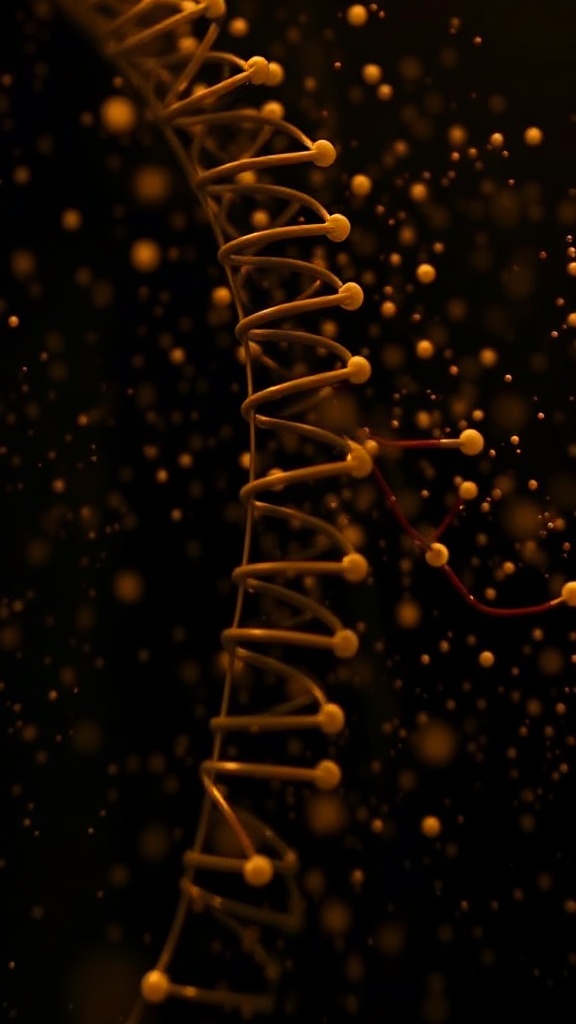
A 70-nanometer DNA syringe punched through a lipid membrane, delivered its cargo, and retracted. The membrane sealed behind it. No nanopore can do that.

On August 11, 2026, a team led by Prof. Laura Na Liu at the University of Stuttgart published a DNA origami nanosyringe in Nature Nanotechnology that actively, mechanically breaches lipid membranes. It is not a pore. It is a programmable, fuel-actuated machine. The device extends a needle, releases its payload, and withdraws on command. The membrane reseals. This is the first time membrane transport has been mechanically controlled in space and time, rather than passively diffused through a static hole.
"Rather than relying solely on passive diffusion through nanopores, the device enables membrane transport to be actively controlled in space and time," Liu said in a university news release.

The plumbing problem that capped a field
Synthetic biology has been stuck with a blunt instrument. The dominant tool for moving cargo across a lipid membrane is the static nanopore—a hole that things fall through when the concentration gradient says so. You cannot turn it on with precision. You cannot turn it off. You cannot retract it. You cannot deliver large, complex cargo without the same hole leaking everything else back out.
Passive diffusion cannot regulate timing. It cannot localize delivery. It cannot protect the compartment from contamination during transport. For a field trying to build programmable synthetic cells that sense, compute, and respond, a static hole in the wall has been a hard ceiling.
The nanosyringe removes that constraint.
Two bundles, one gold nanoparticle, 91% assembly
The device is built from two DNA origami bundles, each roughly 70 nanometers long, crosslinked by a gold nanoparticle roughly 10 nanometers in diameter. One bundle forms a cholesterol-anchored base that locks onto the membrane. The other is a sliding needle driven by DNA strand-displacement reactions—a fuel-and-brake system that steps the needle downward in increments of about 14 nanometers.
Forward fuel extends the needle into the membrane. Reverse fuel retracts it. The tip can be functionalized with molecular cargo: proteins, RNA, DNA. The paper demonstrates membrane-localized hybridization chain reactions, RNA transcription, and catalytic RNA cleavage inside synthetic cells.
Assembly efficiency reached roughly 91%, with 214 correctly assembled syringes out of 236 total imaged by TEM, according to the supplementary information.
The key is reversibility. The needle pierces, delivers, and pulls back. The membrane heals. This is not a puncture wound that leaves the cell leaking. It is a controlled mechanical incision, and the cell closes behind it.
From pores to pumps: the consequences stack up
The mechanism itself is the departure. A fuel-actuated, reversible mechanical breach rewrites what synthetic biology can ask of a membrane.
First-order: spatial and temporal control. Laboratories can now decide when cargo enters a compartment and where the breach occurs, rather than relying on a concentration gradient that equalizes on its own schedule. Biochemical reactions can be triggered at a precise moment, not when the pore happens to let enough substrate through.
Second-order: the race to living cells. The paper proves the principle in synthetic lipid compartments. The obvious next step is to adapt the platform for large protein payloads—those exceeding 100 kilodaltons—into living mammalian cells. The needle tip is a functionalizable surface. Swap the cargo, tune the cholesterol anchors for a different membrane composition, and the same actuation mechanism applies.
Within 12 to 18 months, at least three major synthetic biology labs will publish extensions. The groups most likely to get there first are those with existing DNA origami and membrane engineering programs: the Wyss Institute at Harvard, ETH Zurich, and the University of Cambridge. Roger Rubio-Sánchez, who authored the accompanying News & Views article in Nature Nanotechnology, is already at Cambridge's Department of Chemical Engineering and Biotechnology.
Third-order: capital reallocation. Venture firms that have backed nanopore-based delivery platforms for intracellular cargo will face a hard question. A static pore cannot compete with a tool that inserts, delivers, and removes itself on a programmable cycle. For therapeutic contexts where cargo must enter a cell without permanently compromising the membrane, the nanosyringe offers a mechanism that passive pores cannot match.
The contrarian take is that this is a niche synthetic biology tool—a clever demo in artificial vesicles that will not translate to living systems. That view misses the platform logic. The actuation chemistry is modular. The needle tip is a programmable surface. The base anchoring can be tuned for different membrane compositions. The step size is defined by the DNA strand displacement kinetics, not by the target cell type. The physics of mechanical membrane penetration does not care whether the lipid bilayer wraps a synthetic vesicle or a living cytoplasm.
Passive nanopore approaches for intracellular cargo delivery in therapeutic contexts will be marginalized. The market will pivot from "what can we let through a hole" to "what can we actively inject and retract."
What you do now
If you run a synthetic biology lab, start designing DNA origami needle tips for your target cargo. The assembly chemistry is published. The characterization data is available. The replication window is open.
If you allocate venture capital, begin due diligence on DNA origami delivery startups. The window before the field consolidates around a few leading groups is roughly 18 months. The teams that publish the first living-cell demonstrations will attract the first institutional rounds.
If you are a synthetic biologist, this is the tool that turns a compartment from a bag of diffusing enzymes into a programmable factory with gated inputs. The nanosyringe is not a better pore. It is a different category of membrane transport—one that operates on mechanical logic rather than passive equilibrium.
The healed wound
The 70-nanometer syringe punched through, delivered its cargo, and withdrew. The membrane sealed behind it. The wound is gone. The cargo remains. The field will never be passive again.