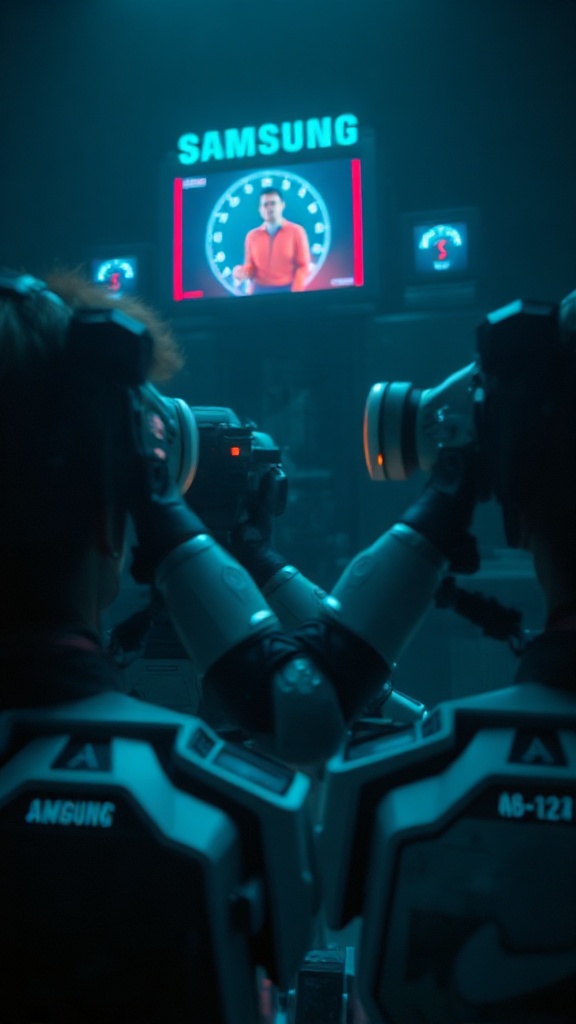
Actuators eat more than 30 percent of a humanoid robot's material cost. Samsung just built its own, adapted from decades of home-appliance motor engineering.

The other 70 percent? Software and data the company already owns. That rewrites the unit economics for every competitor planning to sell hardware by 2028.
Samsung will compete on price first, then lock in distribution through appliance sales channels. Hyundai and Tesla should be reallocating R&D budgets from mechanical engineering to data-center partnerships. Instead, they are still optimizing joints.

A Closed-Door Demo That Changes the Timeline
Samsung Electronics has been quietly developing a humanoid robot entirely in-house for years, separate from both its publicly announced Robotics eXperience (RX) division and its Rainbow Robotics subsidiary. The confidential program is at an advanced stage. Multiple Korean media sources report it already outperforms major domestic rivals.
On August 10, 2026, the company held a closed-door demonstration at its Umyeon R&D campus. CEO TM Roh attended in person. According to Seoul Economic Daily, the prototype carried out precise movements and its completeness was evaluated as surpassing products from global humanoid companies. A domestic industry source told ZDNet Korea that "the level of the humanoid directly made by Samsung Electronics appears to have surpassed major domestic humanoid products."
The project's speed is not an accident. Samsung recruited foreign robotics experts through its Future Robotics Initiative Group in March 2026, covering mechanical development, software, and circuit engineering for humanoids. It appointed Lee Dong-gun, formerly of Hyundai Motor and Boston Dynamics strategy, as head of the Robotics Strategy Team. An internal job posting for robotics talent closed in late July, with selected employees expected to join the RX unit's detailed teams soon.
This is a separate effort from the RX division Samsung launched on July 21, 2026, which reports directly to Roh. The in-house humanoid project predates RX and operates on its own track.
The Cost Component Nobody Else Can Match
Here is the mechanism. According to Interact Analysis's 2026 humanoid market study, joint actuators account for more than 30 percent of total material cost in high-configuration humanoids. In simpler platforms, that number exceeds 50 percent. The actuator is the single largest line item on the bill of materials.
Samsung's proprietary actuators are adapted from its home-appliance motor engineering. The company has spent decades manufacturing motors at scale for washing machines, refrigerators, and air conditioners. That is a supply chain and manufacturing competence no pure-play robotics company can replicate. When Samsung builds an actuator, it is not buying a component from a supplier. It is vertically integrating a cost center it already owns.
This is the structural advantage. Samsung's motor engineering, electronics manufacturing, and global supply chain are sunk costs, amortized across millions of appliances. Applying them to humanoid robots means the marginal cost of the most expensive hardware component collapses. The company is not competing on robot design. It is competing on unit economics, and it starts with a cost base no competitor can match without building a consumer electronics business first.
The Data Pipeline That Runs 24 Hours a Day
The hardware cost advantage is only half the asset. The other half is a training-data pipeline drawn from Samsung's manufacturing operations spanning home appliances, smartphones, semiconductors, and displays. A dedicated Data Factory is planned at the company's Gumi campus to integrate manufacturing process data directly into robot training.
Samsung is also developing a "World Model" AI that learns physics laws from video data, enabling a robot to simulate the outcome of an action before executing it in the real world. Combined with Samsung Gauss, the company's proprietary large language model, this creates a data flywheel: manufacturing operations generate training data, which trains the World Model, which improves robot performance, which generates more operational data.
Competitors cannot replicate this without operating factories at Samsung's scale. Tesla has manufacturing data from its automotive lines. Hyundai has some from its own factories. Neither has the breadth of processes, from semiconductor fabrication to appliance assembly, that Samsung can feed into a single training pipeline. The bottleneck in humanoid robotics is shifting from hardware capability to data ownership. Samsung owns a data generation engine that runs across dozens of product categories.
The Price That Resets the Market
Samsung's play rewrites the competitive landscape through a specific, predictable sequence.
Price comes first. Within 18 months, Samsung will unveil a commercial humanoid robot priced under $150,000. That number is not a guess. It is what becomes possible when the largest hardware cost component is produced in-house using amortized motor technology, and when the software stack runs on a proprietary AI trained on captive data. Tesla Optimus and Hyundai-owned Boston Dynamics are building robots by sourcing actuators and constructing training pipelines from scratch. Samsung is building them from an existing cost structure and an existing data operation. The cost gap is structural, not tactical. It will not close through incremental improvement.
Distribution comes second. Samsung sells appliances through a global retail and B2B channel that already reaches factories, warehouses, and commercial facilities. When a humanoid robot becomes another SKU in that channel, the sales and service infrastructure is already in place. Competitors must build distribution networks while Samsung adds a product line to an existing one. That is a time-to-market advantage measured in years, not months.
Then the market flips. If Samsung commoditizes humanoid hardware, the value in the market shifts entirely to AI training pipelines and data ownership. The company that controls the cost of hardware and the scale of training data controls the unit economics of deployment. Everyone else becomes a hardware manufacturer competing on price against a vertically integrated consumer electronics giant. That is not a fight anyone wins.
The specific prediction: Tesla and Hyundai will be forced to reallocate at least 15 percent of their humanoid R&D budgets from mechanical engineering to data-center partnerships within the next two years. The hardware arms race ends when Samsung sets a price no one can match. The only remaining moat is proprietary training data, and Samsung's manufacturing operations give it a lead that will take years and billions of dollars to close. If Samsung does not ship a sub-$150,000 unit by mid-2028, this thesis is wrong. But every signal, from the actuator strategy to the Data Factory to the closed-door demo, points in one direction.
What This Means for Operators
If you are in manufacturing, logistics, or any labor-intensive industry, the implication is straightforward: humanoid robots will become affordable and available sooner than the consensus expects. The bottleneck shifts from hardware cost to integration and software. Operators should start evaluating their own data pipelines and training needs now. The hardware cost barrier is about to collapse. Companies that have prepared their operations for deployment will capture the productivity gains. Those waiting for prices to drop organically will find themselves behind competitors who saw this coming.
Samsung adapted home-appliance motor engineering to build a humanoid that reportedly surpasses global competitors. The other 70 percent, the software and data, is already inside the company's factories, running on its own AI models, trained on its own processes. Competitors are still optimizing joints. Samsung is rewriting the unit economics of an entire industry. The race is no longer about who builds the best robot. It is about who controls the cost and the data. Samsung just signaled it intends to control both.