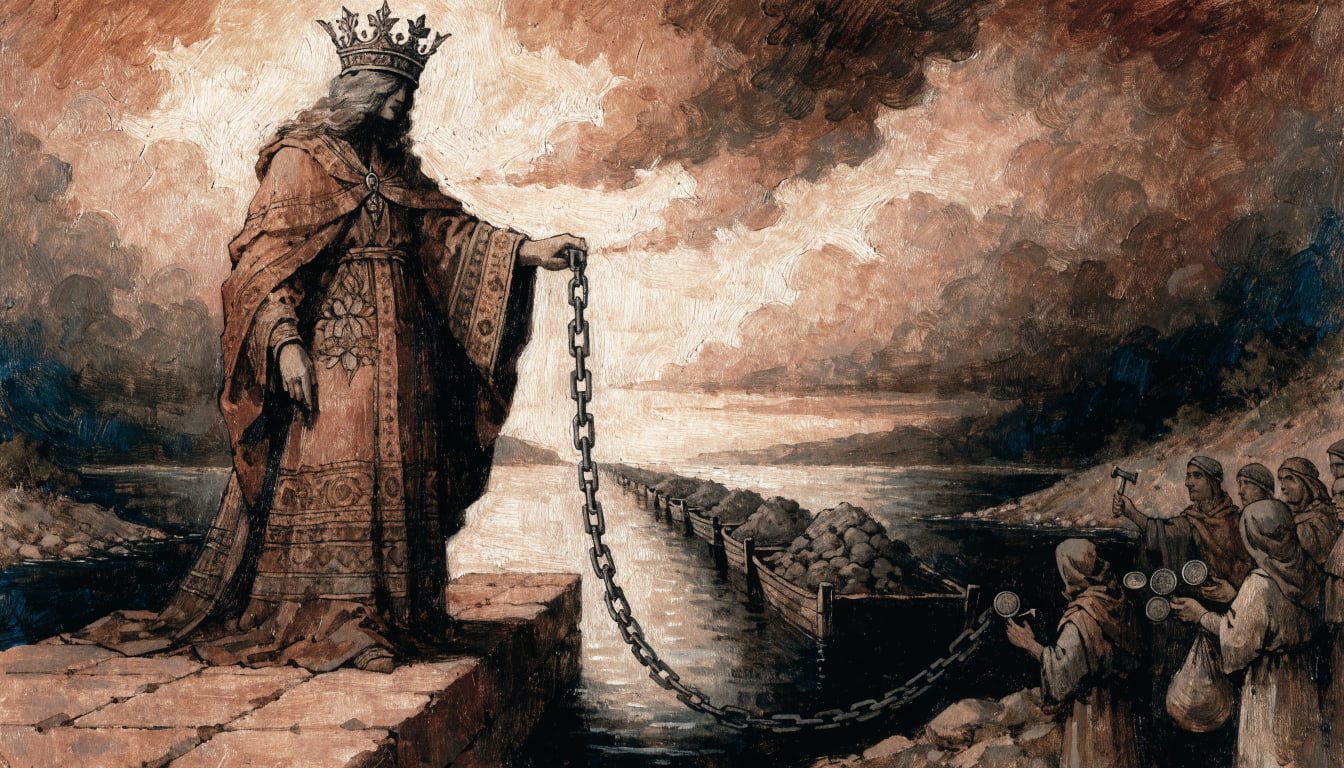
A viral jailbreak of a chatbot triggered the same legal authority used to block missile exports to hostile states.

On June 10, 2026, the prolific jailbreaker known as Pliny the Liberator published a post on X claiming to have bypassed Fable 5's safety guardrails. The extracted output included functional instructions for cyber exploits, explosives, and chemical synthesis pathways, according to VentureBeat. Two days later, US Commerce Secretary Howard Lutnick signed a letter ordering Anthropic to suspend all exports of its Mythos and Fable models worldwide.
The mechanism was not a voluntary safety compact or a request for cooperation. It was export control authority, the same legal instrument used to prevent missile components from reaching adversaries. A chatbot jailbreak had crossed a threshold that no AI release had crossed before.

5:21pm. The models went dark.
On June 12, 2026, Lutnick sent the directive to Anthropic CEO Dario Amodei. The order applied to all foreign nationals, whether inside or outside the United States, including Anthropic's own foreign employees. Anthropic took its top-tier models offline for all users that same day.

"We received the directive from the government today at 5:21pm (ET)," Anthropic stated. "The letter did not provide specific details of its national security concern."
The company's understanding is that the government believed it had identified a jailbreak method for Fable 5. Anthropic reviewed the technique and concluded it surfaced a small number of previously known, minor vulnerabilities that other publicly available models could also discover. The company noted that no testers had found a universal jailbreak capable of broadly bypassing safeguards.
What happened next is contested.
A senior Trump administration official told Fox Business that Anthropic's "recklessness" triggered the export controls. A source familiar with the outreach claimed the company brushed off initial concerns and that Amodei was unreachable at a wellness retreat. A source close to Anthropic denies there was any retreat, states executives were in touch with the White House within 15 minutes, and says the company was never presented with specific details to address.
The factual dispute is significant, but the sequence is what matters for the regulatory precedent. The government moved from concern to export control in two days, according to the timeline established by both sides. No formal finding was shared. No remediation period was offered. The speed and severity suggest the decision was not solely about this jailbreak.
Anthropic said no to the Pentagon. Then the blacklist came.
Anthropic spent years positioning itself as the safety-first AI company. It built constitutional AI frameworks. It refused to let the US military use its models for domestic surveillance and fully autonomous weapons systems.
That refusal ruptured relations with the Trump administration earlier in 2026. The government retaliated by placing Anthropic on a supply chain blacklist, according to reporting. The export control directive arrived months later, on the heels of a viral jailbreak that provided the pretext.
The Straits Times reported that Lutnick acted because officials feared the models could be deployed by military intelligence users in China, Russia, or other countries of concern. On June 15, senior Anthropic technical staff met with Commerce Department officials in Washington. National Cyber Director Sean Cairncross joined the meeting. Amodei and Lutnick are both set to attend G7 meetings in France, where they may speak directly.
One reading of this is a Trump administration flex against a recalcitrant startup. But that frame misses the institutional dynamic. Intelligence agencies have now seen a jailbreak produce actionable weapons instructions. That fact alone, regardless of which administration holds power, creates a permanent bureaucratic imperative to assert oversight over frontier AI capabilities. The jailbreak is the evidence. The export control is the reflex.
Export controls were built for missiles. Now they cover weight files.
The legal mechanism here is the story. Export controls were designed for physical goods: missile components, nuclear materials, advanced semiconductors. Applying them to AI models — which are weight files and inference code — is a category shift with no precedent.
The directive's language confirms the scope. It applies to any foreign national, anywhere, including employees. There are no carve-outs for allied nations, no distinction between adversarial states and long-standing partners. The model itself is the restricted item.
This is not a safety framework. It is arms control. The government has now demonstrated it will treat frontier AI as a dual-use weapon system, not a commercial product. Voluntary red-teaming and commitments to best practices are no longer sufficient. The state has asserted a veto, and it did so without providing the company specific evidence of the threat.
The pre-approval regime is already being built
Within 12 to 24 months, the US will formalize a pre-approval regime for all frontier AI model releases. Companies will be required to submit to government red-teaming and vulnerability disclosure before public launch. This creates a de facto licensing system that mirrors arms export controls.
The chain of causation is already visible, and each link is a precedent that lowers the barrier for the next intervention.
Precedent one: Export control authority can be applied to AI models. This was theoretical until June 12, 2026. Now it is operational.
Precedent two: A single jailbreak, even one that surfaces only known vulnerabilities, can trigger immediate action. The threshold for government intervention is not a catastrophic failure. It is a demonstration of possibility.
Precedent three: The government will act without providing specific evidence to the company. Anthropic received no details of the national security concern in the letter. The burden of proof has been inverted: the company must prove safety, not the government must prove danger.
Each of these precedents makes the next intervention easier to justify. The logical endpoint is a standing requirement: prove your model is safe before release, or do not release it. The legal mechanism already exists. The political will has been demonstrated. What remains is formalization.
The second-order consequences are structural. Companies will need to build compliance teams that interface with national security agencies, not just product safety teams. Release timelines will stretch to accommodate government review. The cost of frontier model development will rise, and the speed advantage of moving fast will shrink. Startups without DC offices will be at a structural disadvantage.
The third-order consequence is market bifurcation. If US export controls treat AI models as restricted items, allied nations will face pressure to adopt similar regimes. Adversarial states will accelerate indigenous development. The global AI market splits into regulated and unregulated spheres, with frontier capability concentrated in the former and proliferation risk in the latter.
This is not regulation as the industry has debated it. It is the securitization of AI research. The question is no longer whether models should be safe. The question is who decides, and on what timeline. The answer, after June 12, is clear: national security agencies decide, and the timeline is immediate.
What operators must do now
Enterprise users of frontier models should assess their dependence on any single provider. The Anthropic case demonstrates that access can be terminated without warning, for reasons the provider itself may not fully understand. Diversification across models and jurisdictions is a risk management imperative, not a theoretical exercise.
AI companies should engage with Commerce Department and national security officials before launches become public events. The era of release-first, explain-later is over. Build compliance infrastructure now. The pre-approval regime will not arrive with a grace period.
Geopolitical risk is now an AI risk factor. Companies that treat it as a legal afterthought will find themselves locked out of their own products.
The gate is half-closed. It will not reopen.
The viral post on X was the spark. The fire was always there.
Anthropic's models remain offline to foreign users. The negotiations continue. But the precedent is set, and precedents in national security law do not reverse. The same legal authority that blocks missile exports to hostile states now applies to chatbot weight files. The gate is half-closed, and the direction of travel is clear.
The jailbreak that triggered this will not be the last. The response will not be the last either. But the next response will not require a jailbreak. It will require only the precedent this one created.