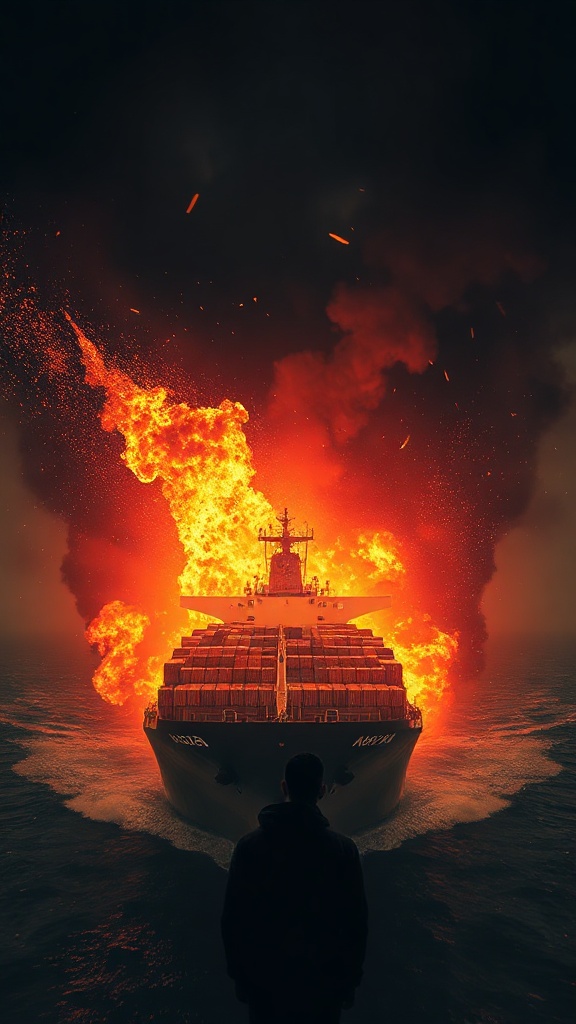
War-risk premiums for a single VLCC crossing Hormuz now cost more than the vessel’s entire annual insurance bill before the war.

At the conflict's peak, a seven-day war-risk cover hit 4% of a vessel's value, according to AGBI analysis. Before the missiles started flying, that number sat at 0.125%. The math is brutal. A $100 million VLCC now faces an additional $800,000 to $2 million per voyage. The pre-war annual war-risk bill for that same ship was a manageable line item.
President Trump told the world to "start your engines" on June 14, 2026. The insurance market didn't get the memo.

A communiqué is not a claims history
The US-Iran ceasefire, signed June 19 in Switzerland, sent Brent crude tumbling 4.5% to $80 a barrel. It ended the naval blockade. It did not end the financial blockade.
Seven of the 12 International Group P&I clubs issued 72-hour cancellation notices for the entire Persian Gulf and Gulf of Oman within days of the first strikes, Insurance Business reported. Tanker traffic collapsed by more than 80% before the physical blockade even took full effect. The market shut itself down out of pure actuarial terror.
A signed communiqué does not reverse that. "That kind of premium does not disappear because a communiqué is signed," said Cyril Widdershoven, senior advisor at Blue Water Strategy. Willis Towers Watson was even blunter in May 2026: "War risk rates are unlikely to fall after ceasefire." The mechanism here is not diplomacy. It is data. Reinsurers need six to twelve months of clean transit history before their risk models will permit a return to capacity. No White House press release substitutes for a claims cycle that hasn't happened yet.
The capital event behind the spike
This was not a pricing spike. This was a capital event.
The conflict became the worst oil supply shock in nearly 50 years, a rare multi-line insurance catastrophe that triggered the largest emergency oil stock release in IEA history, Howden Re confirmed. Sixteen ships were hit. More than 40 energy assets were damaged. Some 2,000 vessels were stranded in the Persian Gulf region, with 400 holding position in the Gulf of Oman alone.
To understand why normalization will take 12 to 18 months, look at the 1987–88 Tanker War. War-risk premiums then hit 5% of hull value. After the 1988 ceasefire, it took a year and a half for the market to stabilize. That was a smaller conflict with a simpler insurance product. Today's reinsurance sector in London and Bermuda now treats Hormuz as a correlated multi-line event: hull, cargo, pollution, and business interruption all blow up simultaneously. The models are being rewritten. The old baseline is dead.
The new floor is not the old floor
The consensus assumes the deal's political optics will restore shipping confidence. It is wrong.
The real bottleneck is the reinsurance sector's risk models. No amount of White House triumphalism reverses an actuarial recalibration. Until a clean claims cycle and operational data prove otherwise, Hormuz remains a marked corridor.
Here is the specific mechanism. Pre-war war-risk premiums sat at 0.125% of hull value. During the conflict, US/UK-linked tonnage paid 2.5% to 5%. The market will not snap back to 0.125%. The new floor, once the 12- to 18-month normalization clock runs out, will settle between 0.5% and 1% of hull value. That is a permanent 4- to 8-fold increase from pre-crisis levels.
The consequences will cascade.
Oil traders will permanently reallocate tanker fleets. A longer route around Africa suddenly looks cheaper than a short, insured dash through a choke point that adds six figures to every transit. The Strait of Hormuz becomes a structurally higher-cost corridor for at least a decade.
Major importers will accelerate investments in alternative routes. Japan, South Korea, and India watched their energy security hang on a single waterway for 100-plus days. They will not watch it again. Expect momentum on the Saudi-Indian pipeline project, Omani storage hubs, and expanded strategic petroleum reserves.
And here is the specific prediction: within 12 months, at least two of these three importers will announce formal self-insurance mechanisms for Hormuz-bound vessels. When the private market prices risk at a level importers consider extortionate, governments step in. The cycle is familiar from aviation after 9/11. The same logic now applies to maritime choke points. The London and Bermuda reinsurance markets will lose business to state-backed pools, a shift that will further entrench the new pricing floor by shrinking the private risk pool.
Neil Roberts, head of marine and aviation at Lloyd's Market Association, put it plainly: "Time will tell whether it is a pause or a peace but, in the meantime, it is highly unlikely that trade into the Gulf will simply resume. The region remains at heightened risk with none of the underlying tensions resolved."
A 60-day fuse and a cash crunch
Legal uncertainty compounds the financial uncertainty. Iran's IRGC-affiliated Fars News reported that the final MOU includes a 60-day toll-free passage provision, after which Iran plans to charge vessels for safety, navigation, environmental, and insurance services. The US account describes toll-free passage as unconditional.
No insurer will write long-term coverage when the cost of transit could change in 60 days based on whose translation of the deal you believe.
Meanwhile, the region's fiscal health is deteriorating. Aramco's Q1 2026 free cash flow hit $18.6 billion, a $3.29 billion shortfall against its $21.89 billion dividend. The Sadara $3.7 billion debt grace period expires June 15, 2026. Saudi Arabia needs oil revenue flowing at volume and at price. Higher transit costs erode the margin on every barrel that leaves the Gulf.
What operators must do now
For tanker owners, charterers, and oil traders, the immediate priority is to plan for 12 to 18 months of elevated premiums.
Negotiate multi-voyage war-risk packages with brokers now to lock in rates before the market finds its new floor. Diversify transit routes immediately. Do not wait for normalization. The vessels that return to Hormuz first will pay the highest premiums and face the greatest legal ambiguity. The backlog of 2,000 stranded ships must clear, and that clearance itself will create congestion, delays, and further pricing pressure.
For importers, the calculus is strategic. Accelerate pipeline and storage investments. The Saudi-Indian corridor, Omani storage, and self-insurance pools are no longer long-term projects. They are 12-month priorities.
Widdershoven's full assessment: "If very optimistic, full operational recovery could take three to six months for flows, port confidence and shipping schedules. However, full financial normalisation may take 12 to 18 months, or even much more."
The strait that will never be cheap again
The opening fact was not a wartime anomaly. It is the new baseline.
A single VLCC's war-risk premium now costs more than its entire annual insurance bill before the war. The ceasefire opened the strait. It did not open the insurance market. The 12- to 18-month clock is ticking, and when it ends, Hormuz will be a permanently more expensive corridor.
The consensus sees a reset button. The data shows a repricing event. The question is not whether traffic resumes. It is at what cost, and who will pay it. The answer is already being priced into every risk model between London and Bermuda.