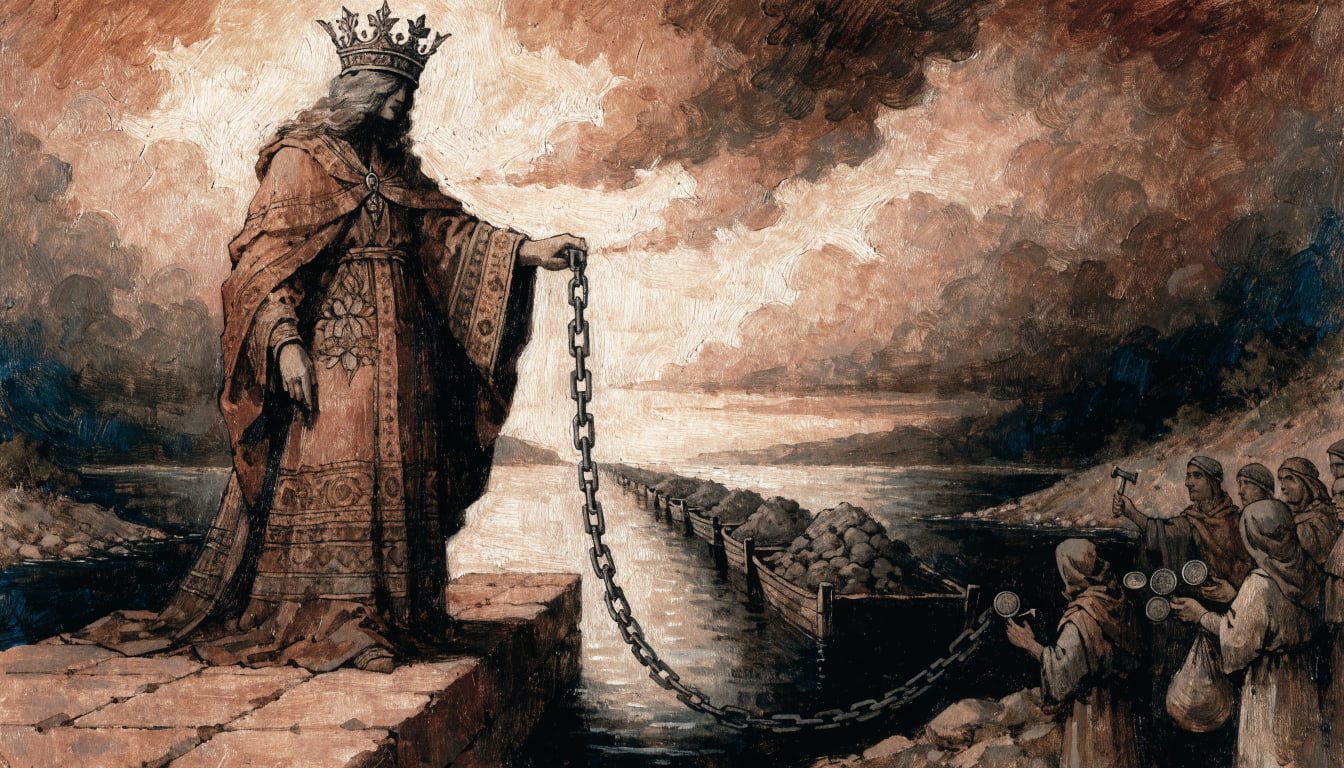
The default posture in crypto is to use ZK proofs for compression and privacy—make transactions cheaper, make dark pools darker—while leaving the structure of the token untouched. Jason Morton, a mathematician and early ZK researcher, urges a harder reset: stop porting the stone-tablet farmer model of money onto new substrates. This talk works because Morton operates from first principles. He treats money not as a store of value or a unit of account but as a zero-knowledge proof that a certain kind of social fact has been witnessed and accepted. From that framing, the design space cracks open. If money is a proof, then programmable cryptography lets us change what gets proven, what stays hidden, and who participates in the verification. Morton doesn’t hand out blueprints. Instead he offers an anthropological lens—the Martian observer—to expose how thoroughly our existing economic forms are shaped by the computational constraints of their eras. The payoff is a taxonomy of what becomes possible when those constraints vanish: non-skeuomorphic economic coordination where communities define and evolve their own value functions without reducing participants to a scalar balance. For practitioners deep in the stack, this is a rare session that treats the primitives you ship as raw material for something larger than better oracle throughput.
Key Takeaways
- Money as a ZK proof: Morton demonstrates that currency functions precisely like a zero-knowledge proof system—attesting to a witnessed social contribution without revealing the full transaction graph or internal state of the participants involved.
- Skeuomorphic lock-in: Current token designs (token_count × last_price) directly inherit the schema of clay-tablet accounting and relational databases, ignoring that blockchain-native computation removes the fidelity/cost tradeoff that forced that schema originally.
- The Martian anthropologist method: A reusable mental model for interrogating which features of an economic system are fundamental versus which are artifacts of the medium—pencil, paper, or SQL—in which money was historically implemented.
- Computational constraint shift as design signal: Morton identifies specific guardrails that were lifted (consensus algorithms, programmable ZK, verifiable computation) and maps them to coordination primitives that were physically impossible before roughly 2016.
- Dignity as objective function: The argument that human contributions need not be compressed into a scalar in order to be composable, and that the design goal shifts from maximizing capital efficiency to maximizing the specificity and legibility of individual value within a community.
Who should watch: Infrastructure engineers and protocol economists who build the primitive layer (ZK circuits, rollup architectures, token standards) and need a higher-level schema for why the design decisions they make at the bytecode level matter for economic coordination.
Why This Matters
Morton’s talk lands directly on a fault line we’ve been tracking: the divergence between crypto projects that treat ZK as an optimization on existing financial rails and those that treat it as a substrate for entirely new coordination games. The ‘secret third thing’ he references—neither capitalist nor communist, feasible only post-2016—is the quiet thesis behind a wave of non-tokenized reputation systems, conditional payment graphs, and subjective oracles that are currently too early to have ETF filings. This talk gives the intellectual framework for that emerging category.