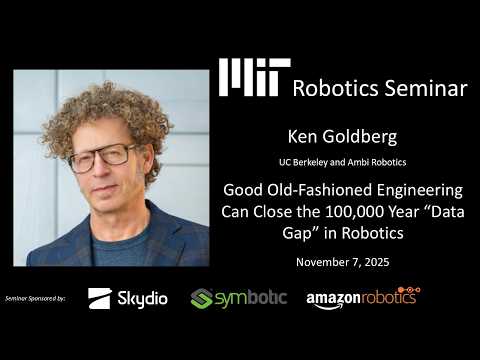
The current playbook for AI is simple: scale data, scale compute, and watch emergent behavior appear. Robotics practitioners know this recipe breaks down the moment you leave the digital world. In this talk, Ken Goldberg quantifies the problem with a stark metric: the 'robot data gap' is roughly 100,000 years of human clock time compared to what large language models consume. That number isn't just a dramatic prop; it's a fundamental signal that we cannot scrape the physical world into submission. Goldberg walks through the Dex-Net project as a case study in generating synthetic grasping data for 3D objects, a direct homage to ImageNet but for mechanics, not labels. The talk then shifts to the messy reality of existing robot datasets like Open X-Embodiment (OXE). The core problem isn't just volume, but indexing and retrieval. You can have a massive dataset, but if you can't find the right demonstration with the right keyframes to train a specific policy, the data is effectively useless. Goldberg presents a container-based approach to data management that treats each demonstration as an indexed, queryable unit. The payoff is a clear-eyed, engineering-first framework: stop waiting for the data gap to close and start building systems that make the data we have actually usable.
Key Takeaways
- The '100,000-year data gap' is a concrete heuristic comparing human reading time for LLM training data versus the clock time required to generate equivalent physical robot interaction data.
- Dex-Net (Dexterity Network) was designed as an ImageNet for robotic grasping, focusing on synthetic 3D object models with labeled grasp points rather than 2D images with text labels.
- The Open X-Embodiment (OXE) dataset, while large, suffers from a discoverability problem: finding the right demonstration category and the specific keyframes for training a targeted policy is extremely difficult.
- Robo Data Management introduces a container model that indexes each demonstration by task and keyframe, transforming a monolithic dataset into a queryable library for fine-tuning specific skills.
- Engineering the data pipeline (curation, indexing, and synthetic generation) is a more immediate and practical path to dexterous robots than waiting for a breakthrough in data scaling.
Who should watch: Robotics engineers and ML researchers who are hitting a wall with imitation learning data pipelines and need a practical framework for dataset curation over raw scale.
Why This Matters
This talk signals a broader shift from 'data hoarding' to 'data engineering' in embodied AI. The bottleneck is no longer just collection but the ability to structure multimodal demonstration data so it can be efficiently retrieved and composed for new tasks.