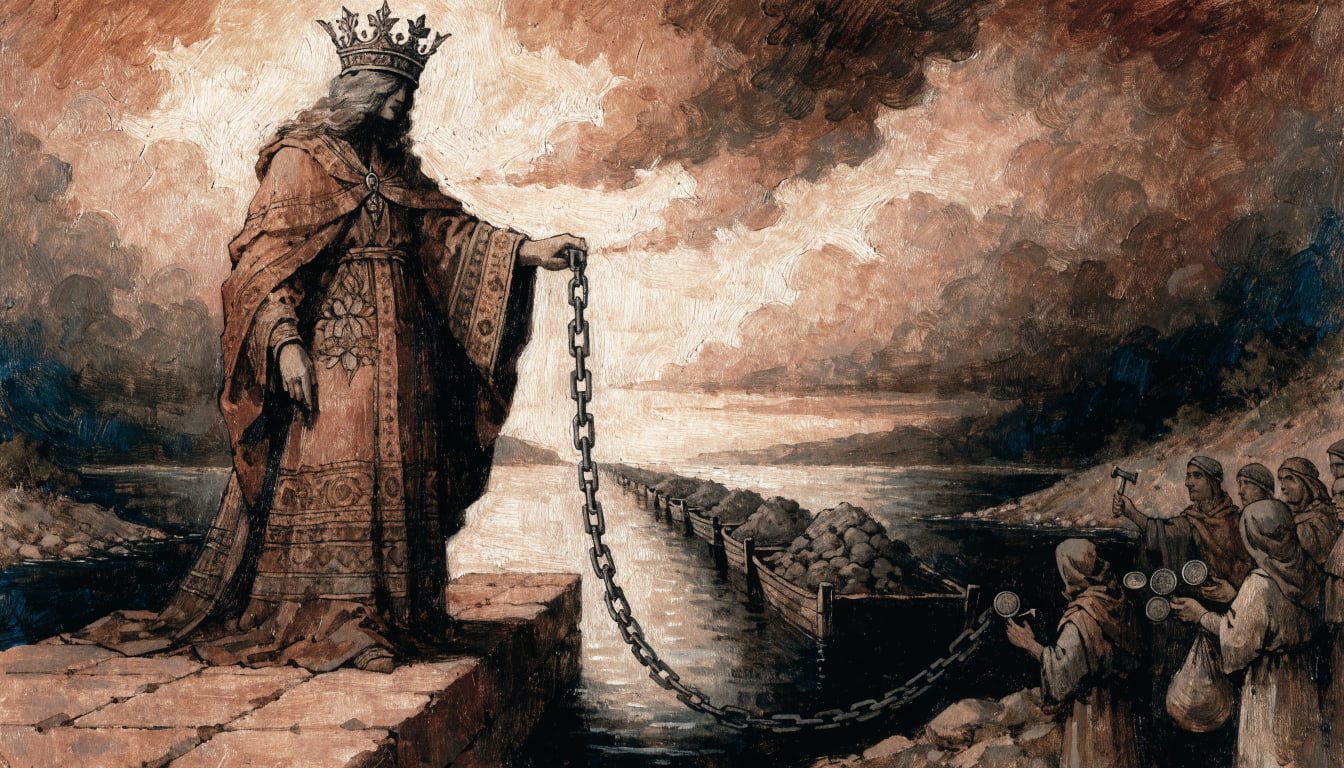
Most on-chain systems still encode ownership the same way a clay tablet or double-entry ledger did: a scalar balance per account. Morton starts from the observation that zero-knowledge proofs plus programmable settlement remove the old verification and consensus constraints, yet the application layer has not caught up. He treats money itself as a special case of a zero-knowledge proof and asks what other proofs become feasible once verification cost drops to near zero. The second half moves from critique to construction, outlining an AI coordination surface and a distributional ownership primitive whose parameters directly expose macroeconomic levers such as inequality and incentive sharpness. The talk stays technical; Morton repeatedly flags that the math is not yet implemented and that the engineering surface is still open.
Key Takeaways
- Current token economies are skeuomorphic ports of stone-tablet or database ownership models onto a cryptographic substrate whose constraints no longer match the old ones.
- Zero-knowledge proofs allow verification of predicates that were previously either impossible or required trusted intermediaries; Morton positions money as one such predicate.
- An AI coordination layer can replace human memory in informal risk-sharing arrangements (e.g., barn-raising) while preserving the same incentive logic at machine scale.
- Fuzzy money replaces scalar balances with draws from a Dirichlet distribution, turning ownership into a shifting probability measure whose concentration and variance become explicit policy knobs.
- Two new macroeconomic parameters appear: distribution peakedness (controls inequality) and distribution definiteness (controls incentive precision), both adjustable without altering contract code.
Who should watch: Cryptographic protocol designers and mechanism engineers evaluating whether ZK or distributional state can replace scalar token balances in their next system.
Why This Matters
We have been tracking the shift from scalar state to distributional or predicate state as the next primitive layer after account and UTXO models; Morton's framing supplies both the cryptographic justification and the first two candidate mechanisms.