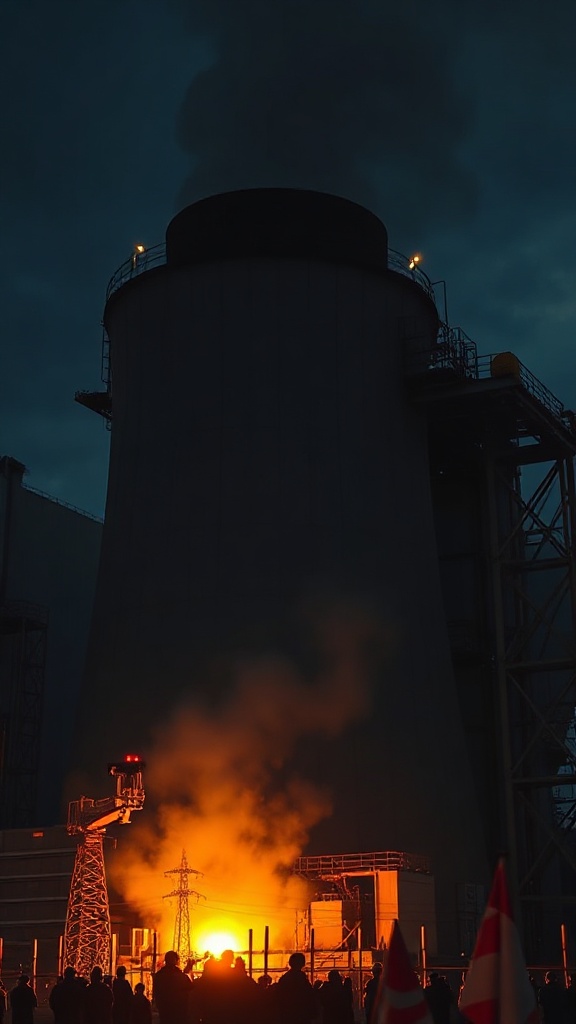
NuScale's VOYGR plant at the Idaho National Laboratory site will supply 60 MW of electricity to the grid before June 30, 2028. The sequence of permits, funding, and physical assembly makes this the narrowest path forward.
The Signal Is Concrete
The 2025 site permit approval cleared the final regulatory hurdle before groundbreaking. Construction began in 2026 on the INL site, a location with decades of operational nuclear expertise and existing security and evacuation infrastructure. The DOE SMR funding announcement 2026 expanded the loan guarantee envelope, removing the last financing bottleneck. These are not speculative events. They are administrative and financial locks that commit multiple institutional actors to a shared timeline.
The Incentives Align
The Department of Energy needs a domestic SMR success to justify its loan programs and maintain congressional support for advanced nuclear. NuScale needs to convert its regulatory first-mover advantage into operational revenue before competitors like GE-Hitachi or TerraPower close the gap. The Idaho National Laboratory needs a modern power source to support its own expanding research missions. Each party loses standing and budget authority if the project stalls. When three large bureaucracies share a single point of failure, the project does not drift. It gets resourced.
The Physics Is Forgiving
A 60 MW light-water reactor is not a first-principles physics challenge. It is an engineering integration challenge. The reactor module is factory-assembled and shipped to a prepared site. Civil construction and component manufacturing run in parallel, compressing the timeline. The technology is an iteration on decades of naval and commercial light-water designs, not a novel reactor type requiring new materials or unproven coolants. Delays in large reactors typically stem from on-site construction complexity and weather exposure. A factory-built module arriving on a truck eliminates the majority of those variables.
The Alternative Is More Expensive
Every year the plant does not operate, NuScale burns cash and the DOE faces questions about its $1.4 billion investment. Utility partners with signed power-purchase agreements need the electrons to meet internal decarbonization deadlines. No actor benefits from a delay. The cost of acceleration, in expedited inspections and overtime shifts, is trivial compared to the carrying cost of idle capital and the political cost of failure. The rational choice for every decision-maker is to push for the earliest possible commercial operation date.
What Changes
When the plant syncs to the grid, the risk premium embedded in every subsequent SMR project collapses. Power-purchase agreements for units two through ten reprice downward. Utility integrated resource plans begin replacing coal retirement capacity with SMR bookings instead of gas peakers. The conversation shifts from "if" to "how many."
What is driving this
- 2025 site permit and 2026 construction start create a committed, irreversible timeline.
- DOE loan guarantee expansion removes the financing barrier after groundbreaking.
- Factory-built module assembly compresses on-site construction to months, not years.
- Multiple institutional actors face career-defining costs if the project slips past 2028.
What would prove this wrong
A critical supply-chain failure in the single reactor pressure vessel fabrication that cannot be resolved with an alternative supplier within 12 months.
The signal
NuScale's 2025 site permit approval and 2026 construction start at the Idaho National Laboratory site, plus the 2026 DOE loan guarantee expansion for SMRs.