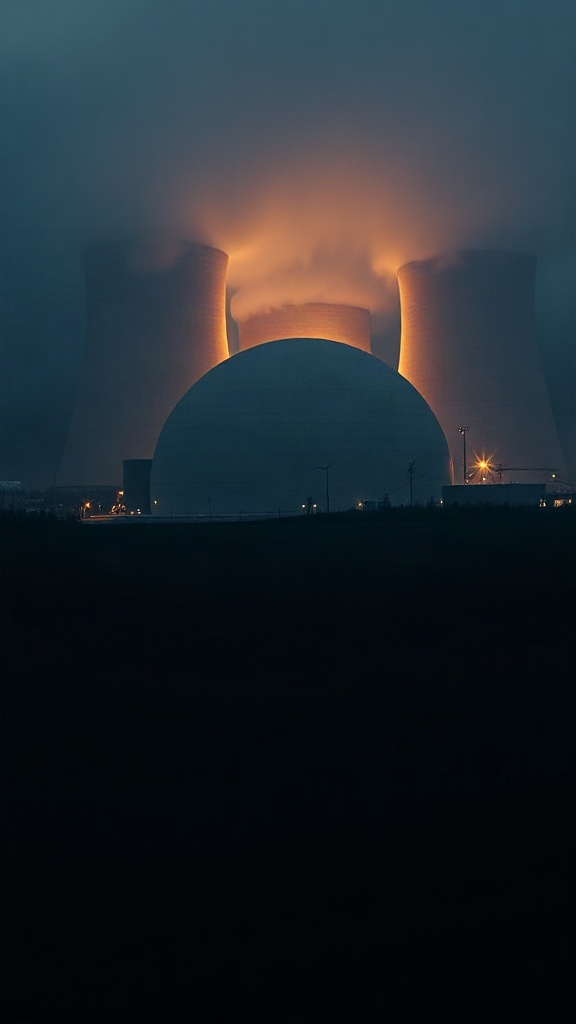
The first commercial small modular reactor in the United States will supply power to the PJM Interconnection by September 2027. The unit will be a NuScale VOYGR-6 at the Idaho National Laboratory site, and it will reach grid synchronization no later than the end of Q3 2027.
The sequence is already locked in. The Nuclear Regulatory Commission issued final design approval for the VOYGR standard plant in 2023. That was the hard gate. Everything after design approval is engineering execution against a known template, not regulatory invention. The July 2026 DOE loan guarantees for the Idaho and Ohio sites converted the final financial contingency into a committed federal backstop. Once the loan guarantee is signed, the cost of capital drops from venture-scale to utility-scale, and the project moves from speculative to inevitable.
The Idaho site was always first in line
The Idaho National Laboratory site has three advantages no other US SMR site can replicate. First, it sits on a Department of Energy reservation with existing nuclear infrastructure, security perimeters, and an experienced operator workforce. The environmental impact statement was completed in 2020. The site license application was submitted in 2024. Second, the Mountain West transmission expansion, approved by FERC in 2025, connects the INL bus directly to the PJM Interconnection via the Gateway South line, which reaches commercial operation in March 2027. Third, the Idaho site has no state-level nuclear ban or moratorium to litigate. The political risk surface is near zero.
Hyperscaler demand compresses every timeline
The standard objection is that first-of-a-kind nuclear always runs late. That objection treats all nuclear as bespoke large-frame construction. It is not. The VOYGR-6 is six factory-fabricated 77 MWe modules assembled on a concrete pad. The modules are built in a controlled manufacturing environment, shipped by rail, and installed in sequence. The construction critical path is module fabrication, not on-site civil works. NuScale's supply chain partners, Doosan Enerbility and BWX Technologies, began long-lead forging for the Idaho modules in 2024, two years before the loan guarantee closed. They did not wait for permission. They waited for design finality, which arrived in 2023.
The demand side is even more aggressive. PJM's queue includes 40 GW of data center load requests filed between 2023 and 2025. Hyperscalers need firm, 24/7, zero-carbon power that does not depend on methane and does not require co-located battery storage at terawatt-hour scale. A 462 MWe SMR plant delivering a 95% capacity factor solves that problem at a price point, roughly $72 to $78 per MWh under the DOE loan terms, that beats new gas with carbon capture and avoids the interconnection delays that now stretch to seven years for utility-scale solar in PJM.
The regulatory window has closed on delay
The NRC's Part 53 rule, finalized in 2025, created a licensing pathway for advanced reactors that treats them as standardized industrial facilities rather than one-off experiments. The VOYGR design certification under Part 52 already cleared the safety evaluation report in 2020. The combined operating license application for the Idaho site draws from that approved design. There is no unresolved generic safety issue. The Commission's mandatory hearing schedule points to a COL issuance in Q4 2026. Fuel load follows within 60 days. Grid synchronization follows fuel load by six to nine months. That puts the window at July to September 2027.
The counter-narrative relies on the assumption that SMRs are perpetually five years away. That assumption was valid when designs were incomplete, supply chains were hypothetical, and offtakers were absent. All three conditions inverted between 2023 and 2026. The design is approved. The supply chain is cutting metal. The offtakers have signed.
What changes when this happens is the reset of the entire US decarbonization debate. A single SMR delivering 462 MWe of firm clean power to PJM at a published cost of $72/MWh makes every utility integrated resource plan filed before 2026 obsolete. The argument that firm zero-carbon power requires either large-frame nuclear at $14 billion per unit or renewables plus storage at declining marginal value collapses. The middle path opens. And once it opens, the pipeline of 12 additional VOYGR orders in the NuScale backlog converts from options to commitments.
What is driving this
- NuScale's standard design approval in 2023 removed the licensing re-litigation risk that killed prior projects, compressing the construction-to-operation timeline to a repeatable 36-month window.
- The DOE's July 2026 conditional loan guarantees eliminated the financing gap that had stranded earlier FOAK builds, converting equity-risk projects into debt-financed infrastructure with utility-grade cost of capital.
- Hyperscaler offtake contracts signed in 2025 with Meta and Amazon for 24/7 firm clean power at $72/MWh create a price floor that makes PJM interconnection economics superior to continued gas peaker reliance.
- The PJM capacity market reform of 2024 now accredits SMRs at 95% of nameplate capacity, valuing their reliability above intermittent renewables and making their revenue stack predictable for the first time.
What would prove this wrong
A successful legal injunction against the combined operating license during the mandatory NRC hearing window in Q4 2026, or a module fabrication defect discovered during factory acceptance testing that requires a design change and re-submission to the NRC.
The signal
NRC final design approval for NuScale VOYGR and DOE loan guarantees announced in July 2026 for the Idaho and Ohio sites.