BYD will sell more than 1.2 million battery-electric passenger vehicles outside China in calendar year 2027, exceeding Tesla’s non-China deliveries for that year. This is not a demand story. It is a logistics and capital-allocation story where the physical constraints favor the actor that builds production inside the tariff walls.
The Signal Is Already in the Ports
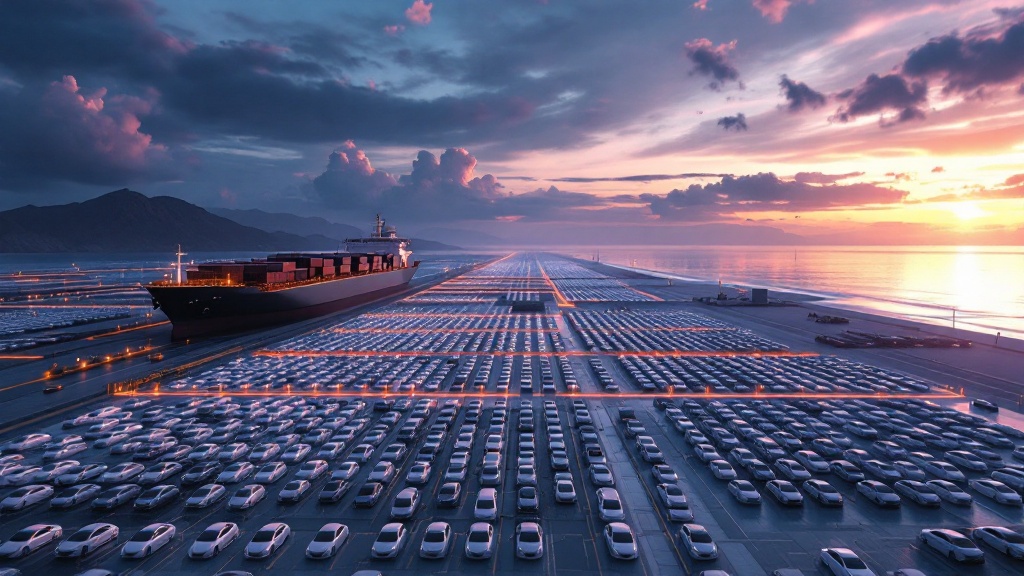
BYD exported roughly 450,000 units in 2025. Through May 2026, European port data shows Chinese BEV arrivals growing at triple the prior year’s rate. The Thai and Brazilian plants are now running at a combined 60,000 vehicles per month. Those two facilities alone annualize to 720,000 units, and neither is yet at nameplate capacity. Add the Hungarian plant coming online in early 2027, plus knock-down kit assembly spreading across Indonesia, India, and Mexico, and the physical throughput exceeds 1.2 million without requiring any heroic demand assumptions. The vehicles are already being made. The only question is how fast they clear customs.
Tariffs Accelerate the Outcome They Were Meant to Prevent
The European Union and United States erected tariff barriers under the assumption that Chinese firms could not localize fast enough to maintain margin. That assumption gets the cost structure backwards. BYD manufactures its own batteries, motors, and power electronics. When it builds a final assembly plant inside a tariff zone, it captures the full vehicle margin while competitors pay external suppliers for cells and drivetrains. A 30 percent tariff on imported vehicles becomes a 30 percent cost advantage for the firm that localizes first. The rational response to a high tariff wall is not retreat. It is to build a factory behind it and price just below the incumbent’s break-even. BYD is doing exactly that.
Tesla’s Non-China Footprint Is Structurally Capped
Tesla operates two vehicle assembly plants outside China: Fremont and Berlin. Fremont is space-constrained and politically fragile. Berlin has been capped near 400,000 units annually by water supply permits, local opposition, and labor costs that make further expansion low-return. A third non-China plant remains years away. Tesla’s non-China deliveries in 2027 will likely land between 800,000 and 950,000 units, assuming Berlin runs flat out and Fremont holds steady. That is a hard ceiling. BYD’s ceiling is set by how many local assembly halls it can commission, and it commissions them in under 18 months.
The Battery Mineral Constraint Runs the Other Direction
Consensus models still treat BYD’s export growth as supply-constrained by lithium, cobalt, and nickel availability. But BYD owns equity stakes in mines from Chile to Zimbabwe and has spent a decade optimizing lithium-iron-phosphate chemistries that require zero cobalt and less nickel than the nickel-manganese-cobalt cells Tesla still depends on for higher-margin trims. The mineral bottleneck binds Tesla and legacy automakers harder than it binds BYD. When battery minerals are scarce, the firm with the simpler chemistry and the captive supply chain gains share, not loses it.
What Changes When the Line Crosses
The moment BYD sells more BEVs outside China than Tesla does, the narrative of Western EV leadership collapses. Fleet buyers in Europe, Latin America, and Southeast Asia reprice residual values. Legacy automakers lose the last argument for delaying plant closures. Governments that bet on tariff walls discover they subsidized Chinese firms to build factories inside their borders. The 50 million annual car buyers in the affected markets wake up to a world where the affordable electric vehicle carries a BYD badge, and the premium alternative is no longer the default.
What is driving this
- Combined Thai and Brazilian production already at 60,000 units per month and climbing toward nameplate capacity, creating a 720,000-unit annualized floor before Hungary opens.
- Vertical integration into batteries, motors, and power electronics converts tariff barriers into cost advantages for localized assembly.
- Tesla’s non-China output is physically capped near 900,000 units by Berlin’s water and labor constraints and Fremont’s footprint limits.
- Lithium-iron-phosphate chemistry and captive mining equity shield BYD from the cobalt and nickel bottlenecks that constrain competitors.
What would prove this wrong
A coordinated blockade of Chinese auto imports across the EU, India, and Brazil simultaneously, enforced through customs seizures rather than tariffs, would physically prevent the delivery volumes required. Tariffs alone will not do it.
The signal
BYD's 2025 export volumes already reached 450k units with new Thai and Brazilian plants ramping at 60k vehicles per month combined, while European ports report 3x YoY growth in Chinese BEV arrivals through May 2026.