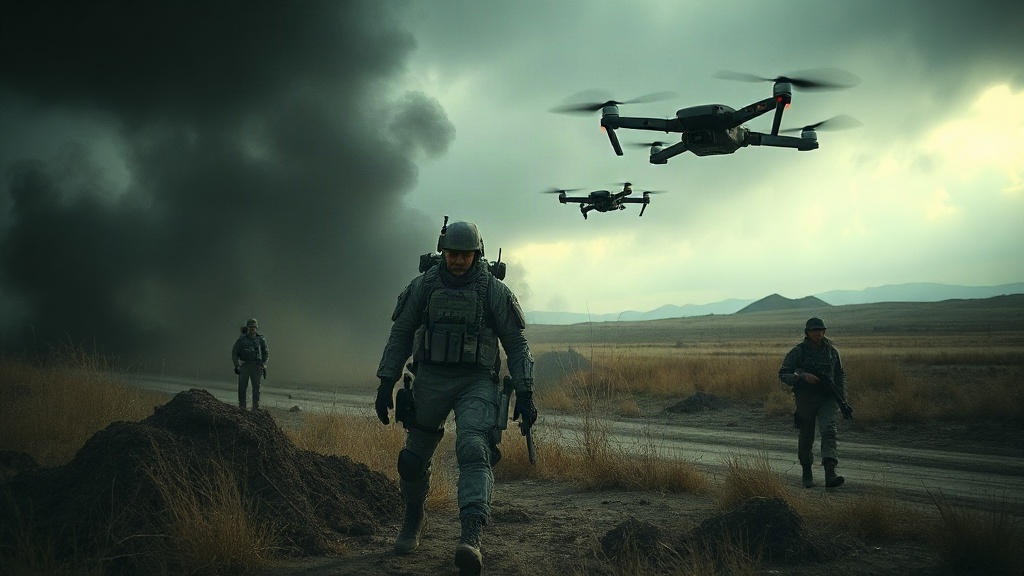
At Fort Bragg, a military demonstration put autonomous systems through three tasks: driving across rugged terrain, cutting a path through a minefield with an explosive charge, and shooting down two drones. Defense Secretary Pete Hegseth has announced initiatives to speed the adoption of drones and artificial intelligence across the U.S. military. Congress is considering safeguards for autonomous systems. The capability is on display; the rules for its use remain unsettled.

But a demonstration is not a deployment order. The reported tests show what the machines did in that event, while leaving unanswered how the military will authorize such systems in combat.
Fort Bragg demonstrated mine clearing, movement and drone interception

One system drove itself for several minutes over rugged terrain. Another fired a long explosive charge that cut a path through a minefield, a task that ordinarily exposes soldiers to danger. A robot gun shot down two drones, according to NPR’s report from Fort Bragg.
Those results establish a bounded set of capabilities: autonomous movement, an explosive mine-clearing operation, and drone interception. The report does not establish the targeting process, the human controls governing the gun, or whether any system shown is ready for operational deployment. A successful demonstration is evidence of performance in that setting, not a description of combat rules.
The mine-clearing task has an evident operational purpose: opening a route without sending soldiers into the immediate danger of the blast. Drone interception presents a different test, because decisions about a weapon’s use carry consequences beyond whether the system can hit a target. The Fort Bragg report gives no details about how that decision was made.
Hegseth pushes adoption as Congress considers safeguards
Hegseth’s initiatives aim to accelerate drones and AI across the military, while Congress considers at least some safeguards. The same broad push is described in NPR’s account and in a separate report on the adoption drive. Neither source specifies the safeguards Congress is considering. The available evidence therefore supports neither a claim that lawmakers are preparing a ban nor a claim that they have settled rules for operational use.
That leaves the central policy question open: what decisions may a system make on its own, and what decisions require human authorization? The answer could shape how systems are tested and fielded. It could also determine whether commanders can use them under clear, accountable limits. Those are implications of the debate, not details already established by the Fort Bragg event.
The present collision is between a military adoption drive and legislative consideration, not between a deployment schedule and a finished law. The pace and terms of adoption remain uncertain.
Delegated control could increase speed and narrow the time to intervene
Human-in-the-loop control places a person in the decision path before an action. Human-on-the-loop control lets an automated system act while a person supervises and may intervene. These are useful distinctions for analyzing the policy debate; the available reporting does not say which model governed the Fort Bragg systems.
Delegated control could reduce delays when a threat develops quickly. It could also compress the time available to detect a mistaken classification or stop an engagement. The trade is not simply speed against safety. It is a choice about which decisions can be delegated, what limits constrain the system, and whether a human operator has enough information and time to exercise oversight.
The mine-clearing demonstration makes the potential benefit tangible: an explosive charge opened a route through a minefield without putting a soldier at the point of detonation. The drone-shooting demonstration raises a harder question about authority over force. Automated performance does not answer who approves an action, who can halt it, or who bears responsibility when it goes wrong.
Verified autonomy could become a procurement advantage within 18 months
My forecast is that semi-autonomous systems could reach operational use faster than Congress enacts safeguards tailored to them within the next 18 months. That is a prediction, not a reported Pentagon schedule. It rests on two confirmed conditions: Hegseth is pressing for faster adoption, and Congress is considering safeguards while demonstrations show systems performing specific tasks.
The prediction depends on a further step that remains unconfirmed: that military demand translates into operational use before lawmakers establish detailed requirements. If it does, contractors will have reason to compete on more than the machine’s ability to drive, clear a route, or intercept a drone. Buyers will need evidence about system limits, testing, and human oversight. That is an inference about procurement incentives, not a documented contract trend.
A supplier that can show how its system behaves within defined boundaries may be easier for a military buyer to evaluate than one offering a striking demonstration without a clear account of controls. Verification could therefore become a commercial differentiator. But the ledger contains no procurement decisions, contractor names, testing standards, or evidence that market share is already shifting. The advantage is plausible; its size and timing are not established.
Safeguards could reinforce that advantage if they create clear requirements that contractors can meet and document. They could slow adoption if they impose conditions that current systems cannot satisfy. The distinction matters: regulation does not automatically favor either faster or slower deployment. Its effect depends on what the rules require and how the Pentagon applies them.
The forecast is falsifiable. It would be weakened if Congress establishes binding safeguards soon and the Pentagon makes compliance a condition for operational use before these systems spread. It would also be wrong if demonstrations fail to translate into programs that commanders can use. Conversely, documented deployments ahead of tailored safeguards would support the timing claim, though they would not by themselves prove that a few contractors captured disproportionate market share.
Within 18 months, the key market test will be whether buyers reward demonstrated control as well as demonstrated capability. The current reporting supplies grounds for that forecast, but no basis to call consolidation inevitable.
Military doctrine will have to define acceptable algorithmic risk
If autonomous systems enter operational use, commanders will need to decide which tasks can be delegated and what safeguards govern them. A system that moves or responds without constant human direction may change how a unit plans around mines or aerial threats. The Fort Bragg demonstration does not establish reliability in combat, deployment at scale, or the rules that would govern such use.
The doctrinal issue is accountability under time pressure. A human supervisor may retain formal authority while having little time to understand or stop an automated action. Meaningful oversight would depend on system limits, operator access to relevant information, and a practical ability to intervene. The sources do not establish how those conditions are being addressed; they are the questions raised by the capability and the legislative debate.
Autonomous weaponry faces a test of oversight, not just performance
At Fort Bragg, autonomous systems drove across rugged terrain, cut a path through a minefield, and downed two drones. Hegseth is pushing for faster adoption, while Congress considers safeguards. The demonstration makes the policy debate concrete, but it does not show that deployment is inevitable or that rules have been settled.
The next test is whether oversight can be made specific enough to govern the systems the military wants to adopt. The equipment has demonstrated tasks. The authority to use it remains a question for military leaders and lawmakers.