Microsoft’s new quantum chip has 12 qubits and a 2029 deadline to reach millions.
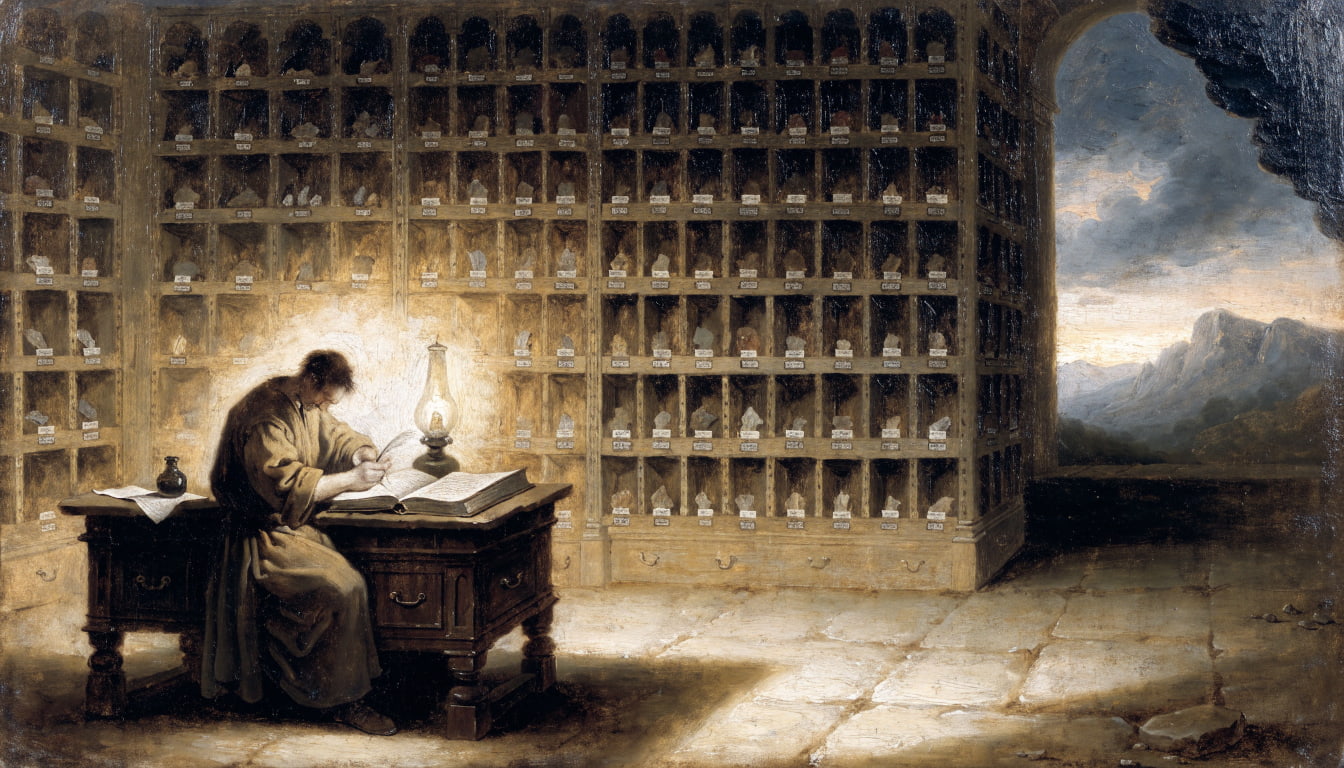
 Medieval builders examine a flawless lead block, symbolizing the controversial material switch behind Majorana 2's reliability gains.
The company unveiled Majorana 2, its next-generation topological quantum chip, claiming a 1,000-fold improvement in qubit reliability over its predecessor. The mean qubit lifetime is 20 seconds, with some instances lasting a minute. Microsoft now targets a scalable quantum computer by 2029, halving its original timeline. The press release is a victory lap. The math is an impossible sprint. A commercially viable fault-tolerant machine requires millions of qubits. This chip has 12. The gap between the demo and the deadline is the real story, and it sets up a credibility crisis that will hit long before 2029 arrives.
 Microsoft's fragile clipper sprints toward a 2029 deadline, unaware of the hidden reef beneath the surface.
The 20-year bet and the lead switch
Microsoft has spent 20 years pursuing topological quantum computing, an approach designed to produce qubits that are inherently protected from errors. The physics community has met that pursuit with deep skepticism, especially after last year’s claims faced intense scrutiny. The fundamental promise remains compelling: if you can create and control Majorana zero modes, you get qubits that don’t need the massive error-correction overhead of superconducting competitors.
The single most impactful decision in the Majorana 2 breakthrough was switching the superconducting material from aluminum to lead. That change, which Microsoft says is primarily responsible for the reliability improvement, came out of years of conventional materials research, not an AI recommendation, according to artificialintelligence-news.com. The topological gap, which protects qubits from environmental noise, more than doubled. IBM and Google continue to pursue an incremental superconducting approach, stacking physical qubits into logical ones through brute-force error correction. Microsoft is betting the house on a completely different physics regime—one that, if it works, skips that overhead entirely. The catch is that no one outside Microsoft can verify if it works.
What Majorana 2 actually is
The chip has 12 qubits. The topological gap is more than double the previous processor’s. The 1,000x reliability number measures qubit lifetime and stability improvements over the prior generation. What it doesn’t measure is performance in a multi-qubit, error-corrected environment. That benchmark doesn’t exist yet. Microsoft does not release full details of its discoveries publicly, citing commercial confidentiality, the BBC reports. Independent verification is currently impossible.
The agentic AI angle is real but secondary. Microsoft Discovery’s AI agents managed fabrication workflows, automated measurements that previously took weeks each, and surfaced correlations from nearly two decades of siloed research data, according to artificialintelligence-news.com. These are workflow optimizations that compressed the R&D timeline. The platform is now generally available as a Frontier R&D product. The AI acted as a lab orchestrator, not a theorist. The core physics insight—swap aluminum for lead—was stubborn, human-driven materials science. The AI accelerated the testing; it didn’t conceive the hypothesis.
The scaling trap
Physics is no longer the bottleneck. Scaling is. A 1,000x reliability improvement on a 12-qubit chip does not extrapolate to a million-qubit machine. Qubit quality and qubit quantity are separate problems, and the second one is a manufacturing, control, and integration nightmare that has barely been touched. The 2029 deadline is a narrative trap. Microsoft has framed it as a delivery date for a commercially viable machine. Zulfi Alam, corporate vice president of Microsoft Quantum, told the BBC: “We will have a quantum machine in 2029 that can solve commercially viable, reasonable problems.” That is a specific, falsifiable claim attached to a hard calendar date.
Within 18 months, Microsoft will face a credibility crisis when independent benchmarks fail to replicate the 1,000x reliability claim in a multi-qubit, error-corrected environment. The current numbers come from single-qubit or simple two-qubit demonstrations under controlled lab conditions. Scaling introduces crosstalk, fabrication variability, and control wiring complexity that degrade performance exponentially. The physics community, already skeptical after last year’s retracted claims, will demand data Microsoft currently refuses to release. When that data fails to materialize or underwhelms, the company will be forced to walk back the 2029 timeline.
What happens next is a pivot, not a collapse. Microsoft will recast the machine from “fault-tolerant computer” to “valuable scientific instrument.” Paul Stevenson, physics professor at the University of Surrey, captured the conditional nature of the achievement when he told the BBC: “Microsoft appears to have made a leap in their attempt to produce viable topological qubits. If they succeed, they will leap from being a player with no production quantum computer, to being a serious player in the race to make the next generation of fault-tolerant machines.” The key word is “if.” A scientific instrument produces insights, not commercial workloads. That pivot cedes the near-term quantum advantage race to IBM and Google, whose transparent, incremental superconducting approaches will hit smaller but verifiable milestones while Microsoft chases the topological horizon.
This is a category error being exposed in real time. Microsoft marketed a research milestone as a product roadmap. The 1,000x number is a genuine physics achievement. It is not a scaling achievement. The industry will learn the difference the hard way.
What to watch next
The quantum-curious executive, investor, or policymaker should ignore qubit quality claims in isolation. Watch the scaling claims. Ask whether a company has published a multi-qubit error-correction benchmark with independent verification. If the answer is no, the timeline is aspirational. The real near-term value in quantum computing lives in scientific instrumentation, not commercial optimization. Microsoft’s eventual pivot to that framing will be the signal that the industry is finally getting honest about what the hardware can actually do. Pay attention to who publishes independent benchmarks and who doesn’t. Paul Stevenson’s conditional endorsement is the correct posture: wait for data.
The agentic AI story is a separate, more immediate bet. Microsoft Discovery is a platform play that monetizes R&D workflow automation regardless of whether topological qubits scale. That business doesn’t need a 2029 deadline to generate revenue.
The 12-to-millions sprint is not Microsoft’s problem alone. It belongs to the entire industry. A scalable quantum computer requires millions of qubits. No one has a clear path to that endpoint. The 2029 deadline will break something—a timeline, a reputation, a funding thesis—but what emerges might be more honest than what came before. The starting gun on the topological era has fired. It is also a countdown clock.