Microsoft just shipped a quantum chip whose qubits stay stable long enough to do useful work—and the manufacturing race now has a hard deadline: 2029.
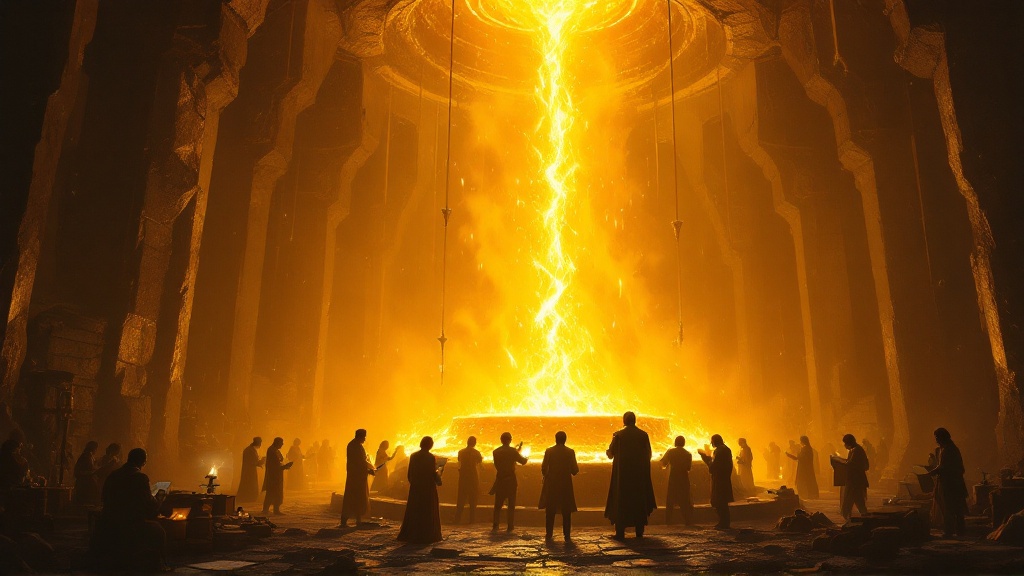
 The scene evokes the cross-disciplinary coordination and automated assistance needed to accelerate quantum chip manufacturing.
What happened
Microsoft unveiled Majorana 2 on June 2, 2026. The chip records a 1,000‑fold improvement in qubit reliability over its predecessor. Mean qubit lifetime sits at 20 seconds, with some instances exceeding one minute. Operations run at one microsecond. Each qubit measures 1/100th of a millimeter. The company states it will deliver a scalable, commercially valuable quantum computer by 2029, cutting its original roadmap in half.
 The diverging fates of the fleets symbolize the widening gap between competing quantum computing approaches.
The acceleration mechanism has a name: Microsoft Discovery, an agentic AI platform now generally available. The AI synthesized nearly two decades of research data, identified patterns across physics and engineering disciplines, automated measurements, and surfaced manufacturing defects. “The AI is able to synthesise knowledge from all these different disciplines,” Zulfi Alam, corporate vice‑president for quantum at Microsoft, told Computer Weekly.
Here is the core shift: when qubit coherence jumps from milliseconds to double‑digit seconds, the remaining obstacle is not proving Majorana particles exist. It is fabricating them with industrial repeatability. Microsoft has reframed quantum computing as an engineering and data problem—and it built the AI factory to solve it.
The leap from doubt to validation
The Majorana 1 chip debuted to deep skepticism. The quantum community questioned whether Microsoft had truly created topological qubits. Bloomberg described Majorana 2 as “a sequel to a research device that generated controversy in the close‑knit quantum‑computing community when it debuted a year ago.” Microsoft needed hardware data, not more papers.
Majorana 2 delivers that data through a new materials stack. The superconductor shifts from aluminum to lead. The semiconductor active region combines indium arsenide and indium arsenide antimonide. The topological gap—the energy buffer that shields qubits from environmental noise—is more than double that of the previous processor, according to Chetan Nayak on Microsoft’s quantum blog.
Qubit lifetimes tell the story in numbers. Majorana 1 recorded 1 to 12 milliseconds. Majorana 2 exceeds 20 seconds as a mean, with maximum lifetimes beyond one minute. That is not an incremental physics refinement. It is a process‑control breakthrough enabled by AI‑driven materials iteration.
AI ate the bottleneck
The consensus treats the 1,000x reliability jump as a physics triumph. It is not. The physics of Majorana qubits were understood. The manufacturing was the black box.
Microsoft’s quantum team operates across multiple countries and fuses physics, mechanical engineering, and process engineering. Agentic AI now coordinates this distributed expertise. The system ingests cross‑disciplinary data, manages engineering dependencies, and recommends material and process changes. Cycle times collapsed because measurements and materials testing were automated.
This rewrites the competitive dynamics. The moat in quantum computing is shifting from Nobel‑class physics talent to proprietary manufacturing data and the AI models trained on it. Microsoft already owns the cloud and AI infrastructure to scale that flywheel. Pure‑play quantum companies must buy compute and build data sets from a cold start.
The race to a 2029 deal
A commercial quantum computer that works as advertised is a decadal economic weapon. Pharmaceutical and materials companies will pay for exclusive access because molecular simulation at scale remakes drug discovery and industrial chemistry.
My prediction: within 18 months, a major pharmaceutical or materials science company will sign a multi‑year, multi‑million‑dollar exclusive access deal with Microsoft for a 2029‑era quantum system. That contract will validate the roadmap with cash, not applause. It will trigger a talent and resource stockpile by competitors that will leave at least one major superconducting program strategically stranded.
IBM and Google have built credible superconducting machines and advanced error‑correction demonstrations. But topological qubits carry inherent error protection. Combine that physics head start with an AI‑accelerated manufacturing engine, and the lead becomes self‑reinforcing if the 2029 milestone holds. A rival that cannot match the iteration velocity risks an “also‑ran” designation by 2028—well before the 2029 machine powers on.
This is not a condemnation of superconducting qubits. It is a recognition that the race has shifted terrain. Microsoft is now competing on factory throughput and AI model quality. That is a fight shaped by Azure and Discovery, not just by a quantum lab in Copenhagen or Santa Barbara.
What you should do with this
Three implications for tech leaders, investors, and policymakers.
First, quantum‑safe cryptography planning just gained a hard edge. 2029 is a commercially useful machine, not a speculative science target. Organizations with multi‑decade data sensitivity must treat key rotation and crypto‑agility programs as urgent, not exploratory.
Second, AI‑accelerated R&D platforms are proven force multipliers. Discovery helped Microsoft cut its quantum timeline in half. The same template—ingest proprietary experimental data, automate testing, surface process changes—applies to batteries, alloys, and specialty chemicals. If your R&D team is not instrumenting its experiments for an AI layer, your cycle time is a competitive liability.
Third, first‑mover advantage in quantum access will compound. The predicted pharma or materials deal is a market signal. It says that locking in early capacity creates a multi‑year information advantage that competitors cannot buy off the shelf in 2030. If your industry relies on molecular‑scale science and you are not on a quantum roadmap, you are already behind.
The quantum computing “science project” era is closed. The bottleneck is no longer physics. It is AI‑accelerated manufacturing engineering. June 2026 just started the clock on a winner‑takes‑most race, and a 2029 commercial system will only confirm a competitive order that was set years earlier.