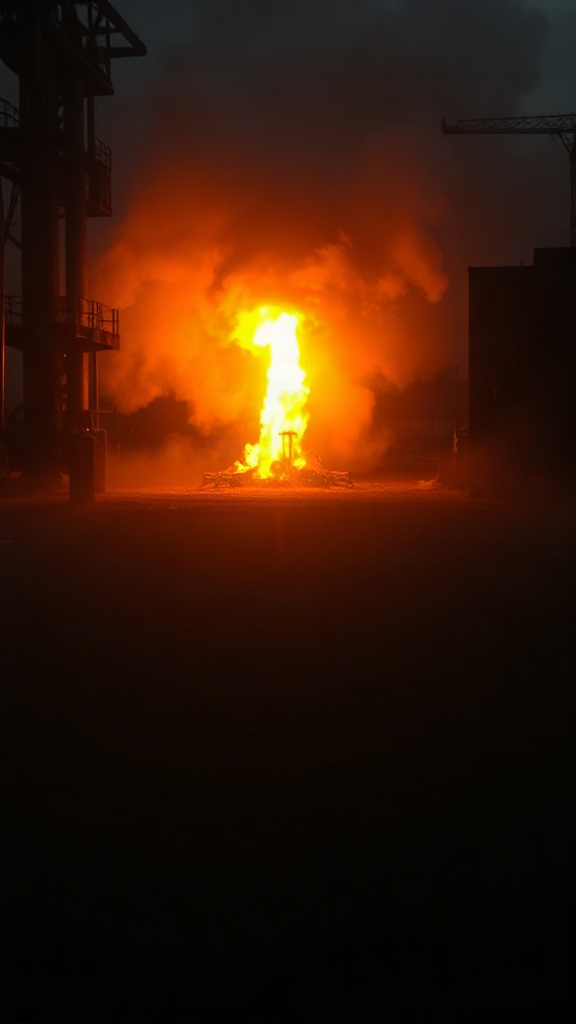

A steel mill in Louisiana will supply SpaceX rockets.
Hyundai Motor Group Executive Chair Chung Euisun said it himself at a groundbreaking ceremony in Donaldsonville on September 4, 2026: "I hope that as we continue our work here, we will be able to supply steel for rockets for companies like SpaceX." The Korea Herald reported the statement. This is not a distant aspiration. It is a hard signal of the technical standard this facility will meet from day one.

That facility is Hyundai-POSCO Louisiana Steel LLC (HPLS), a joint venture that just broke ground on a 7.37 million square meter site. The total investment: $5.8 billion. It is the first electric arc furnace (EAF)-based integrated steel mill in the United States to combine all production stages, from raw materials to finished coils, in a single location. Commercial production targets 2029, with an annual capacity of 2.7 million metric tons. Of that, 1.8 million tons will be automotive steel sheet. The remaining 900,000 tons will serve other applications. The project will support 5,400 total jobs, including 1,300 direct positions.
Three generations, one balance sheet
The ownership structure tells you who is serious. Hyundai Steel holds 50 percent. POSCO holds 20 percent. Hyundai Motor takes 15 percent, and Kia Corporation takes the final 15 percent. MK confirmed the split. This is not a supplier relationship. It is a single balance sheet, stretched across mining, steelmaking, stamping, and final assembly.
Hyundai founder Chung Ju-yung dreamed of vertical integration from iron ore to automobile. His grandson Euisun is now executing it on American soil. The $5.8 billion mill is part of Hyundai Motor Group's $26 billion U.S. commitment, and it arrives in a moment when U.S. steel tariffs — specifically the 25 percent Section 232 duties — make imported automotive sheet expensive. But tariffs were not the primary driver. Chung addressed this directly: "Tariffs were not the goal, but we are in a situation where we need to produce and use locally made steel." MK
The real play is control. Control over the metallurgical quality of exposed body panels. Control over the carbon footprint that will determine which vehicles qualify for Inflation Reduction Act incentives and which automakers meet tightening fleet emissions rules. Control over a supply chain that no longer crosses an ocean.
Why legacy mills cannot match this
Traditional integrated mills rely on blast furnaces and basic oxygen furnaces (BF-BOF). They burn coal to melt iron ore. The process emits roughly two tons of CO2 per ton of steel. Most U.S. mini-mills use electric arc furnaces to melt scrap, which cuts emissions but limits the grades of steel they can produce. High-end automotive exposed panels — the outer skin of a car — demand tight tolerances and surface quality that scrap-based EAFs struggle to hit consistently.
HPLS breaks that constraint. The mill pairs an electric arc furnace with an on-site Direct Reduced Iron (DRI) plant. DRI uses natural gas, and eventually hydrogen, to strip oxygen from iron ore without melting it. The resulting sponge iron feeds the EAF as a virgin iron source, free of the tramp elements that accumulate in recycled scrap. The combination slashes CO2 emissions by an estimated 60 to 75 percent versus a blast furnace while producing steel clean enough for the most demanding automotive and aerospace applications.
This is the first facility in the United States to integrate EAF and DRI at this scale and target the high-value sheet market directly. The 1.8 million tons of automotive sheet will supply Hyundai Motor and Kia's U.S. plants. The press release from Hyundai Steel confirmed the mill will deliver "high-quality, low-carbon emissions steel to global automakers." That language is a direct shot across the bow of legacy blast furnace operators and mini-mill producers who have not yet integrated DRI.
The chain that breaks the old steel order
Here is what happens next. The sequence is already in motion.
The cost and carbon advantage becomes a competitive weapon. By 2029, HPLS will produce automotive sheet with a carbon footprint legacy mills cannot touch without a complete rebuild of their production lines. Automakers facing their own Scope 3 emissions targets and regulatory pressure will have a binary choice: buy low-carbon steel or pay a premium — in cash or in compliance costs — to stick with incumbents. The steel itself is the same product. The embodied carbon is the differentiator.
The SpaceX signal rewrites the quality ceiling. Aerospace-grade steel requires certifications and tolerances far beyond automotive sheet. Chung's public statement that he wants to supply SpaceX rockets is a disclosure of intent. A mill built to chase those certifications from day one will clear the automotive quality bar with room to spare. Legacy producers who have not upgraded their melt shops and rolling mills will face a competitor that outclasses them on emissions and matches them on quality, at a lower cost base.
The predictable response. Within 12 to 24 months, at least one major U.S. legacy steelmaker will announce an integrated EAF-DRI facility targeting automotive and aerospace grades. The two most likely candidates are Nucor, which already operates DRI plants but has not fully integrated them with a sheet mill of this ambition, and U.S. Steel, which faces an existential need to replace aging blast furnace capacity. The market pressure HPLS creates will force the decision. The alternative is ceding the most profitable segment of the flat-rolled market to a vertically integrated competitor that also builds the cars the steel goes into.
Then there is the automation wildcard. Hyundai Motor Group owns Boston Dynamics. Chung Euisun told reporters that steel from the Louisiana mill "should certainly be used" for Atlas humanoid robots and that deploying Atlas inside the mill for hazardous work is something "we will first test extensively, and if it looks feasible, we will move forward with it." The Korea Herald Hyundai already plans to deploy Atlas across its U.S. vehicle manufacturing operations in 2028. The steel mill, with its extreme heat, fumes, and heavy lifts, is a harder environment. If the testing succeeds, humanoid robots will enter the most dangerous zones of the mill. The labor cost reduction — estimated at 15 to 20 percent in those roles — is secondary. The real shift is a precedent: heavy industry automation moving beyond fixed robotic arms to general-purpose humanoid machines operating alongside, or in place of, human crews.
The loser is already visible. Traditional blast furnace operators who cannot pivot fast enough will be stranded. A BF-BOF mill cannot be incrementally retrofitted to match an EAF-DRI facility on emissions. It requires a wholesale replacement of the ironmaking step. That takes capital, permitting, and time that the 2029 start date does not grant. The mills that delay the decision will find themselves competing on a product — high-quality sheet — where their cost structure is higher and their carbon penalty is rising. The market will bifurcate. Integrated EAF-DRI producers will take the high-value sheet. Blast furnace operators will be pushed into commodity grades and plate, where margins are thinner and import competition is fiercer.
The steel mill in Louisiana does not just supply Hyundai's assembly lines. It rewires the economics of automotive steelmaking in North America. The combination of vertical integration, low-carbon production, and a quality target that reaches from car doors to rocket bodies creates a structural cost and compliance advantage that legacy mills must match or lose the market.
What you should do starting tomorrow
If you source automotive steel, the carbon price is arriving. HPLS will deliver low-carbon sheet at scale by 2029. Your competitors who lock in supply agreements early will have a cost and compliance advantage. Waiting means negotiating from a weaker position when the capacity is booked.
If you run a legacy steel mill, start your EAF-DRI feasibility study this quarter. The permitting timeline alone for a DRI plant and associated infrastructure runs years. A 2029 competitor is not a distant threat. It is a deadline you are already late to meet.
If you invest in U.S. steel equities, watch for the response announcements. A major integrated EAF-DRI commitment from Nucor or U.S. Steel will reprice the sector. The company that moves first and credibly will be rewarded. The one that defends its blast furnace base without a transition plan will not.
Chung Euisun framed the mill's reach plainly: "Steel produced locally in the U.S. will play a key role in building the infrastructure for next-generation mobility and AI data centers." Asia Business Daily The Hyundai Steel US steel mill 2029 target is not a regional supply chain hedge. It is a bet that the steel industry's future belongs to those who control the ore, the energy, the robots, and the customer, all on one site. The rest of the industry has three years to decide whether to match it.