China’s tomato crop begins with seedlings grown in greenhouses, where leaf condition offers an early view of nutrient supply, photosynthetic capacity and water stress. The Food and Agriculture Organization figures cited by Bioengineer put 2024 production at about 61.65 million tons and yield at roughly 56,700 kilograms per hectare; production rose steadily from 2010 to 2024. Yet assessing seedlings has generally meant fixed spectral platforms, handheld sampling or offline image acquisition.

A Qingdao team has joined that measurement task to greenhouse navigation. Its robot uses reflected light to estimate seedling condition, with an image-based quality gate checking the target before a spectrum is recorded.
Qingdao’s robot checks a leaf before recording 27 bands

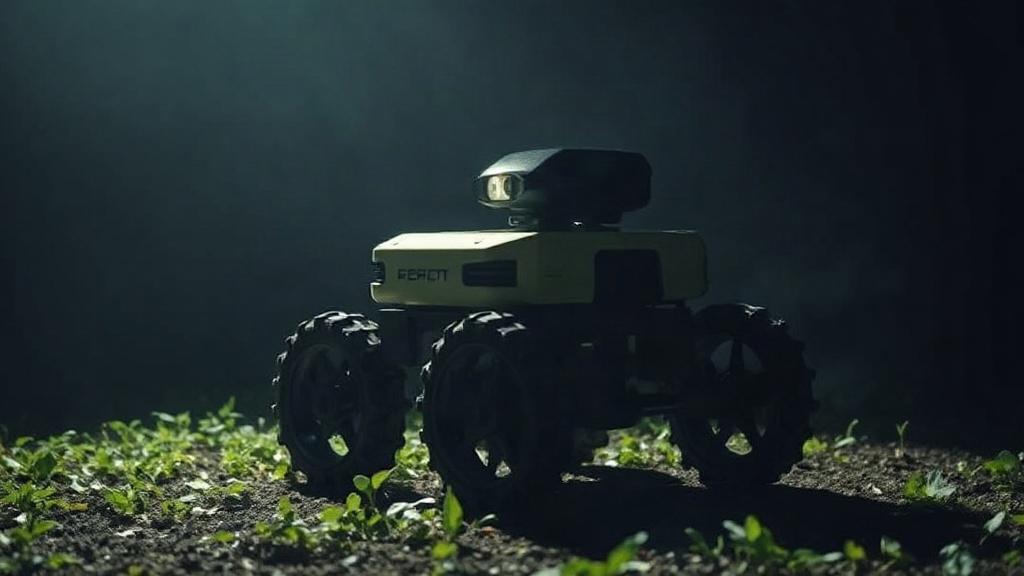
Researchers led by Huili Zhang and Yuliang Yun at Qingdao Agricultural University built and field-tested a four-wheeled robot described in Smart Agricultural Technology. It navigates greenhouse aisles, aims a multispectral camera at individual tomato seedling leaves and reports chlorophyll, nitrogen and moisture status without touching, cutting or chemically treating the leaf, according to Bioengineer’s report.
The indicators represent different aspects of plant condition. SPAD serves as a proxy for chlorophyll and photosynthetic potential. Nitrogen supports chlorophyll, protein and enzyme formation; moisture affects cell turgor, stomatal regulation and transport within the plant.

A model can infer those properties from reflected light, but the spectrum has to come from the intended tissue. The reported image-based quality gate checks that the camera is looking at healthy leaf tissue before the system stores a reading. That verification step makes target selection part of the measurement workflow. The available coverage does not report the gate’s error rate or explain how “healthy” tissue was validated, so its practical reliability remains an open point.
Laser navigation connects each spectrum to a place and time
The workflow maps the greenhouse, plans a route and positions the platform by a leaf. Image analysis checks the target; the robot then stores the spectrum against a timestamped navigation task, according to Scienmag’s account. Laser-based navigation, target verification and spectral analysis therefore operate as steps in one process.
The robot uses a Panda four-wheel differential-drive chassis measuring 0.47 by 0.35 meters, with a 68,000 mAh battery. The compact dimensions suit the greenhouse-aisle task described in the reports. Its machine-learning pipeline turns 27 bands of reflected light into three physiological indicators.
The connection to navigation gives each reading a recorded task and context. That is a meaningful distinction from a spectrum collected without a linked location or timestamp. The reports do not establish how precisely the robot localizes each leaf, how quickly it can collect readings, or whether the system can repeat measurements consistently. Those details will determine whether the workflow produces dependable crop records outside a field test.
The reports establish a prototype, not commercial performance
The available accounts describe the robot, its field test, laser-based navigation, image-based quality gate, 27-band pipeline, reported indicators, chassis and battery. They are secondary coverage of the journal work, rather than the primary paper. The Bioengineer article appeared September 25, 2026, under the byline “Bioengineer”; Scienmag’s version appeared the same day under Denise Maddox’s byline.
Neither account supplies accuracy figures, throughput, cost, a commercial partner or patent status. The production and yield figures are also reported through Bioengineer, rather than independently checked here against FAO data. The evidence supports an integrated research system; it does not establish a saleable product or a performance advantage over existing methods.
That distinction matters to the market argument. A greenhouse robot that can reach a target and verify the camera’s view could reduce the gap between navigation and usable measurement. But the reports do not show whether its readings are accurate enough, or its operation fast and inexpensive enough, to change nursery practice.
If the approach proves reliable, the product-level value may shift toward systems that combine movement, target verification and recorded measurement. A handheld multispectral device could remain useful as a sensor, while a navigation platform could remain useful as a mobile base. The more consequential competition would be over who integrates those components into a workflow that operators can trust. The prototype points in that direction; it does not yet prove that standalone devices or navigation-focused robots will lose their markets.
A repeated spectrum tied to a navigation task could also give plant scientists a more organized record of where and when readings were collected than an unanchored handheld measurement. Whether those records improve prediction or management is unreported. The next evidence to watch is concrete: validated measurement accuracy, collection rate, repeatability and results from operational greenhouse trials.
The project’s ownership is similarly unresolved. The reports give no patent status or licensing deal. If the team patents the quality-gate method, it could seek to license the workflow; if it publishes the method openly, other builders could adopt it without relying on a single supplier. Neither outcome, nor the likelihood of manufacturers copying or licensing the design, is established by the current evidence.
My forecast is that greenhouse robotics will put more emphasis on systems that link sensing to autonomous tasks over the next 12 to 24 months. I expect at least two Chinese agtech manufacturers to license or reproduce a similar workflow, and I expect early commercial units, if they emerge, to target high-value seedling nurseries in Shandong or Yunnan before the end of 2027. These are predictions, not reported developments. No manufacturer partnership, patent or commercial deployment appears in the accounts; the forecast would weaken if follow-up work remains limited to research trials or if accuracy, throughput and cost prove inadequate.
The seedling leaf remains the test for greenhouse crop monitoring
China’s reported 61.65 million tons of tomatoes in 2024 began with seedlings whose condition could be assessed through indicators such as SPAD, nitrogen and moisture. Earlier spectral work often relied on fixed platforms, handheld sampling or offline acquisition. The Qingdao robot brings those readings into an autonomous greenhouse workflow, while leaving its accuracy and commercial viability unreported.
For greenhouse robot crop monitoring, the practical advance is a system that navigates to a leaf, checks its view and records reflected light with task context. The prototype still needs performance data before nurseries can know what it will change in routine grading or management.
Patent or publication could shape who controls the workflow, but neither path is confirmed. For now, the result rests on a more basic decision: whether the robot can find the right leaf, verify the tissue and make a measurement that holds up.