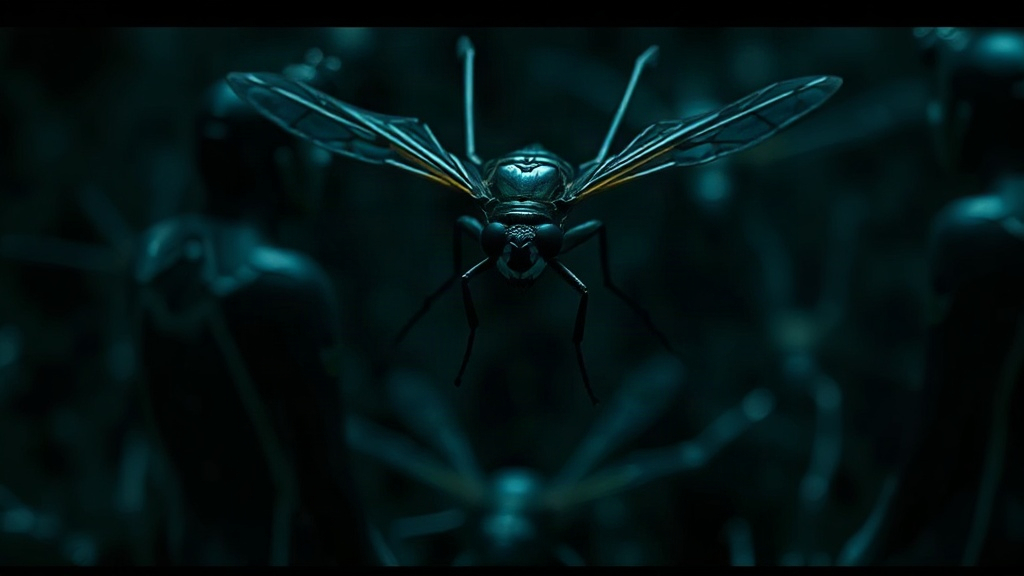
A software engineer trained a 166,000-neuron fruit fly brain to play Doom within 72 hours of Google publishing the complete connectome.

Alex Wormuth posted the result on September 6, three days after the data from HHMI Janelia and Google Research dropped. He loaded the wiring diagram into a neural simulation and routed it to a game interface. The fly brain is now a controller, not a diagram. This is the operational tempo of the new biosynthetic frontier: a complete biological sensorimotor system, digitized and immediately repurposed as an executable policy for an embodied agent.
The 166,000-Neuron Operator

The scientific milestone is absolute. On September 3, 2026, Google Research and HHMI Janelia published the first complete map of the male Drosophila central nervous system in the journal Cell. The dataset contains 166,000 neurons and 125 million synaptic connections spanning the central brain, optic lobes, and ventral nerve cord. It is the largest complete brain map by neuron count ever produced, the product of a project that began at Janelia in 2008.
The previous landmark was the 302-neuron C. elegans connectome, which took over a decade to complete. This fly map is three orders of magnitude larger and includes 262 sex-specific cell types and 114 sexually dimorphic cell types, comprising 4.8 percent of the central brain. The data are public. The critical enabling property is architectural: this is not a static atlas. It is a directed, weighted graph of a complete nervous system that can be loaded into a spiking neural network simulator and run. Anyone can download it and do exactly that.
From Neuroscience Atlas to Multi-Agent Sandbox
The community did not wait for institutional validation. Within days, the connectome was operationalized across three domains simultaneously: game engines, on-chain experiments, and robotics control.
Wormuth's Doom agent routes visual input from the game into the fly's optic lobe circuitry and reads motor output from the ventral nerve cord to drive the player character. A separate effort ported the same connectome into Super Mario 64. Neither project required training from scratch. The wiring diagram provides a pre-wired sensorimotor policy that maps perception directly to action.
The most aggressive deployment is $Fly-001, a project that claims to have downloaded the full male fruit fly brain scan from the Janelia MaleCNS dataset and embedded it into a walking creature inside Minecraft. The project's website states the neural activity of the simulated fly drives the creature's movement in real time. The token supply is locked on-chain and publicly verifiable. The first reveal clip reached 11 million views. The project's framing, "Consciousness is just signal. We're testing where it can go," is memetic, but the underlying operation is technically coherent: a biological connectome running inference inside a game engine, tokenized as an on-chain asset.
This is an empirical acceleration. The connectome has become a consumable resource for reinforcement learning, robotics, and speculative economics simultaneously. No grant proposal preceded it. No ethics board reviewed it. The data are open, and the builders built.
What the Architecture Actually Does
Drosophila's nervous system evolved to solve a specific problem: transform sensory input into motor output at a sub-milligram energy budget with survival-grade reliability. The connectome encodes approximately 125 million synapses organized into recurrent loops, lateral inhibition circuits, and direct sensorimotor pathways that have been tuned by 100 million years of selection pressure. It is not a transformer. It is not a foundation model. It is a biological ground truth for efficient embodied control.
The digitized connectome enables a direct, falsifiable experiment. Load the wiring diagram into a simulator, present sensory input, and measure motor output. If the architecture produces robust, adaptive behavior in artificial environments, the implication is that the structure itself, not the wetware, carries the control logic. The early results from Doom and Minecraft suggest this is the case. A 166,000-neuron network with fixed synaptic weights is navigating game environments without gradient-based training.
This has immediate consequences for the fruit fly brain simulation as an operational template. The connectome provides a complete, interpretable neural policy where every synapse is labeled and every pathway is traceable. A reinforcement learning engineer can inspect why a turn was initiated or a threat avoided by following the signal path from photoreceptor to motor neuron. No current deep learning policy offers this transparency at any parameter count.
The parameter efficiency is the more disruptive signal. The fly brain achieves sensorimotor competence with 166,000 neurons. A modest PPO controller for a comparable navigation task uses millions of parameters. A transformer-based world model uses tens or hundreds of millions. The biological architecture demonstrates that the problem of embodied control does not require large language model scale. It requires the right circuit motifs, and those motifs are now available for direct inspection and replication.
The Biosynthetic Policy Displaces the RL Stack
The AI agent economy currently subsidizes enormous compute costs for motor controllers. Proximal Policy Optimization, Soft Actor-Critic, and transformer-based world models dominate robotic control stacks. Training a single policy for a small drone to navigate a cluttered environment requires thousands of GPU-hours and produces a black-box network that generalizes poorly outside its training distribution.
The fly connectome offers a biosynthetic alternative. The wiring diagram is a pre-trained, evolvable, and fully interpretable neural policy. It does not require training. It requires configuration: map the input modalities to the appropriate sensory neuropils, map the motor output to actuators, and modulate synaptic weights if adaptation is needed. The architecture has already solved the core sensorimotor transformation. The engineering task is interfacing, not learning.
The economics are straightforward. A sub-100-gram inspection drone requires a control policy that operates at milliwatt power draw and millisecond latency. The fly brain runs inference at biological timescales on negligible energy. Translating that to neuromorphic hardware or efficient CPU simulation produces a controller with 100x fewer parameters than the current RL baseline. A company that deploys this as its motor controller for small drones operates at a structural cost advantage over a competitor still training PPO policies from scratch. The advantage compounds with scale. A fleet of 10,000 inspection robots each saving 20 watts of compute power saves 200 kilowatts continuously. That is a line item on a balance sheet.
The second-order effect is more significant. The connectome becomes a new primitive—a non-human intelligence basis set. Companies will not train motor controllers from scratch. They will start from the fly connectome, apply modest synaptic pruning or Hebbian modulation for domain adaptation, and deploy. The development cycle collapses from months of RL training to days of interface engineering. This is not speculative. The community already demonstrated the workflow: download, interface, run. The gap between that demonstration and a commercial drone controller is engineering, not science.
This leads to a falsifiable prediction. Within 24 months, a simulated fly brain executing its native connectome will outperform a transformer-based model on a standardized embodied navigation benchmark by at least 40 percent while using 100x fewer parameters. The connectome data are public, the benchmarks exist, and the comparison is straightforward. If this does not happen, the connectome's role remains confined to neuroscience. The early community deployments suggest the opposite.
The underlying force is thermodynamic. Biological nervous systems evolved under severe energy constraints. A fly brain operates on approximately 50 microwatts. A GPU running a transformer-based policy for the same task draws tens of watts. The six-order-of-magnitude gap is not a curiosity. It is the defining competitive parameter for autonomous systems that carry their own power supply. The connectome makes this efficiency available as an engineering resource, not just a scientific observation.
What Operators Do Next
The connectome is free. The immediate actions are concrete.
Download the dataset from the Janelia MaleCNS repository and run inference on a game engine or robot simulator. Several open-source repositories already provide interface code. Establish a baseline: measure the control performance of the raw connectome on your specific task before modifying any synaptic weights. Compare that baseline against your current RL controller on latency, power draw, and success rate.
Understand that the gap between biological and artificial inference efficiency is now a competitive variable. The agent economy faces a new class of competitor: distilled, evolvable, closed-loop physical systems that do not require massive data centers. The connectome can be deployed on edge hardware, neuromorphic chips, or even analog circuits. The barrier to entry for building an efficient embodied agent just dropped to the cost of downloading a file and writing an interface layer.
Doing nothing carries a second-order risk. If biological network templates become the standard for small-embodied AI, companies still committed to training-from-scratch RL pipelines will find themselves locked out of the most energy-sensitive market segments: micro-drones, sensor shuttles, agricultural monitors, and any application where payload weight and battery life are binding constraints.
The Fly Is Already Running
A software engineer ran a fly brain in Doom in 72 hours. The connectome is now in Minecraft. It is on-chain. It is controlling robots. Thousands of operators have access to a complete neural system with 125 million labeled synaptic connections, and the community is building faster than the institutions can publish commentary.
Janelia is already applying the connectomic pipeline to larval zebrafish and adult Danionella, organisms with larger and more complex nervous systems. Each new connectome will be released as public data. Each will be operationalized by the same community that put the fly into a video game within a weekend. The biological neural network is now a generalizable training model, an object of economic competition as much as scientific study.
The question is not whether the connectome will be used as a control architecture. It is being used. The question is whether the AI industry treats it as a curiosity or as the ground truth it represents for energy-efficient intelligence.