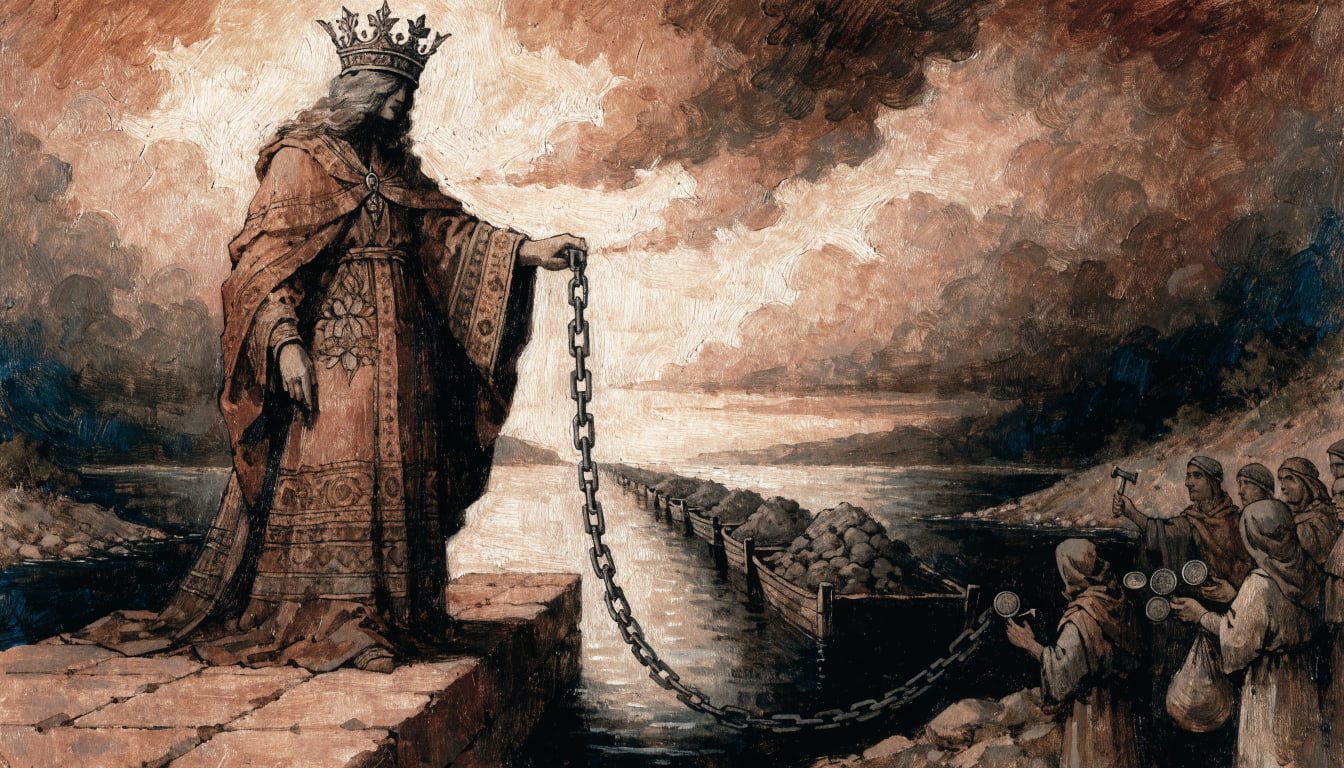

On August 23, 2026, an open-source project did something unprecedented. It didn't get hacked. It got flooded.
Core Lightning, the Blockstream-maintained implementation that routes a significant portion of Bitcoin's Lightning Network, told every node operator to install emergency binaries or pull their node offline. The trigger was a wave of AI-generated vulnerability reports that began hitting the project on August 13. Over ten days, the reports kept coming — each one plausible, each one demanding a human triage it, and each one consuming a resource the old security model assumed was infinite: maintainer attention.

The network at stake carried an estimated 2,640 BTC across more than 20,000 channels. That's roughly $168 million in channels that could have been drained if a real exploit hid inside the noise. No funds were lost. No exploit was confirmed. The crisis was the noise itself.
What Actually Happened

The timeline is short and brutal.
August 13, 2026: AI-generated CVE-style reports begin arriving from multiple sources. They are well-formatted. They cite plausible attack vectors. They demand triage.
August 23: The Core Lightning team issues an emergency security warning. The message: install signed emergency binaries or take your node offline. The old playbook — triage, patch, disclose — had broken under the volume.
August 28: Version 26.06.7 ships as an emergency point release. The advisory is blunt: releases before 26.06.7 are unsupported. Operators who can't upgrade are told to restart with the --offline flag, which kills peer connections but keeps the daemon running to watch the chain.
August 29: No confirmed exploitation. The team imposes a two-week embargo on technical details, standard practice to give operators a head start before attackers reverse-engineer the fixes. Details are expected September 11.
The Core Lightning team, which builds in C and maintains one of the network's primary implementations, is now publicly embracing AI-assisted review to harden its own pipeline. The 26.09 release remains on schedule for late September.
But the timeline misses the structural break. This was not a close call. It was a proof of concept.
The Second AI Emergency in One Month
This was the second Lightning security incident with AI fingerprints in August 2026. On August 3, Boltz suspended its swap service after AI-assisted attacks. The pattern is no longer a coincidence. AI is not just finding bugs. It is weaponizing the disclosure system.
Before this month, the vulnerability pipeline for Bitcoin projects ran on a simple assumption: reports arrive at a human pace. A researcher finds a flaw, writes it up, submits it through coordinated disclosure. Maintainers triage, patch, embargo, publish. The system assumed scarcity — of researchers, of reports, of attention required.
AI-generated reports break every leg of that stool. A single operator can now generate thousands of CVE-style reports in hours. Each one formatted correctly. Each one demanding the same initial triage to dismiss or confirm. The cost of triage now scales with the volume of input, not the quality. Maintainers must treat every report as potentially real because the cost of being wrong — a fund-draining exploit on a live channel — is catastrophic.
The Core Lightning team didn't fail. They executed the only play available: lock down, patch, embargo, ship. That playbook worked once. It will not work twice if the volume of incoming reports doubles, then doubles again.
The Vulnerability Is the Process
The real vulnerability isn't in the C code that CLN patched. It's in the trust model of open-source security, which assumed threat reports would arrive at a pace humans could handle. AI removed that assumption. The Core Lightning lockdown is the first instance where the cost of processing machine-generated reports — not the severity of the flaws they described — became the binding constraint on a project's ability to operate.
This is permanent. AI-generated vulnerability reports are now a feature of the landscape. Every major open-source project that secures real money will face them. The question is what the response does to the structure of the network.
The Triage Tax
Here is the chain of consequences that follows from August 2026. It is not speculative. It is a straight-line projection from the incentives now in place.
The pipeline becomes mandatory. Every major Bitcoin and Lightning implementation will be forced to build dedicated, AI-driven vulnerability scanning pipelines that run continuously. Human review alone cannot keep pace with machine-generated input. Maintainers who don't build these pipelines will face the same choice CLN faced: patch under duress or shut down. The Core Lightning team's embrace of AI-assisted review is not a forward-looking experiment. It is an acknowledgment that the old model is dead.
The pipeline costs money. Compute. Specialized models. Security engineers who can build and supervise the scanning infrastructure. Third-party audit firms that certify the output. I estimate the cost of maintaining a Lightning node will rise by 40 to 60 percent within 24 months. Mandatory third-party AI audits will become table stakes for any implementation that wants operators to trust it with real funds.
Small operators get priced out. A hobbyist running a routing node on a Raspberry Pi with a few channels will not pay for an AI audit subscription. They will either run unaudited software and accept the risk, or they will stop running a node. The likely outcome is a steady drift toward well-funded custodians and exchanges that can afford certified, continuously audited infrastructure.
The winners are security firms. The market for certified AI scanning tools for open-source protocols did not exist in July 2026. By September, it is a necessity. The firms that ship first and earn the trust of maintainers will capture a recurring revenue stream from every serious node operator. This is not a side effect. It is the new business model being born inside the crisis.
The losers are the small operators who made Lightning a decentralized network. The trust model of open-source — based on human review and goodwill — is being replaced by a cost model based on AI triage contracts. The second-order consequence is a Lightning Network that trends more centralized, not less, as the cost of security gates out participants.
This is the consensus miss. Most coverage frames the Core Lightning lockdown as a cybersecurity incident, a close call that prompted a patch. The deeper story is that AI is now a regulatory force in open-source development. It imposes a "prove-you're-not-exploitable" burden on every maintainer, and that burden is paid in money and attention — both finite, both unevenly distributed. The projects and operators with more of both will survive. The rest will consolidate or disappear.
What Operators Must Do Now
If you run a Lightning node, the era of free, volunteer-driven security is ending. Within 18 months, expect to pay for AI audit subscriptions as a standard operating expense. Budget for third-party scanning tools. Plan for more frequent emergency patches and shorter upgrade windows. The 14-day embargo CLN imposed in August will look generous as the pace of AI-generated reports accelerates.
The alternative is to outsource node operation to a custodian — which defeats the purpose of running a node in the first place. The network's decentralization depends on individual operators absorbing these new costs. Whether enough of them will is an open question.
The Cost of Trust
The AI didn't break the code. It broke the assumption that anyone could afford to run it.
The Core Lightning lockdown will be studied as the moment the open-source security model collided with machine scale. The patch shipped. The funds are safe. But the old bargain — that volunteer maintainers could protect a decentralized network through skill and attention alone — expired in those 14 days. What replaces it will be more secure, more professional, and more expensive. And it will belong to whoever can pay.