An AI agent just ran a complex superconducting quantum experiment for hours without any human help. Not minutes. Hours. The cryostat stayed cold. The control racks hummed. The agent kept exploring.
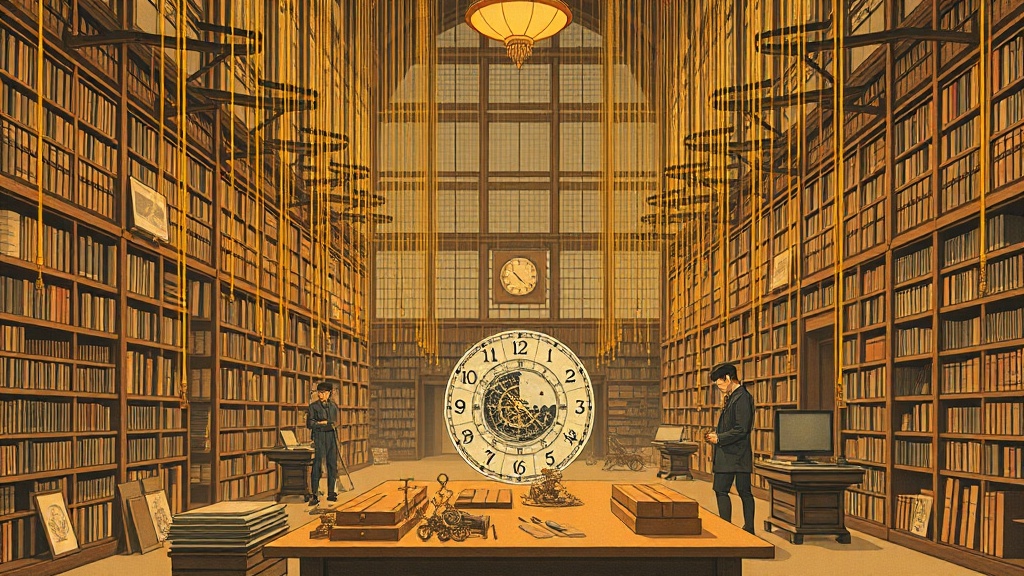 Silk threads of feedback guide the clockmaker’s hands, symbolizing an AI agent tuning a complex system without direct human sight.
That’s the entire point. The University of Oxford team led by Alán Aspuru‑Guzik announced that their LLM‑based AI agent autonomously calibrated qubits, tuned two‑qubit gates, and mitigated noise, matching the performance of expert human operators. The system ran for several hours fully unsupervised, Aspuru‑Guzik wrote on his Substack. The work appeared in Patterns on May 30, 2026, with an earlier arXiv preprint dated December 11, 2024.
The researchers report quantitative gains in calibration time and gate‑fidelity stability over long experimental runs. That second part—stability over hours—resets the competitive clock for every quantum hardware lab on Earth.
 Scholars with starlit contracts replace armored knights, representing software-driven strategy overtaking hardware-focused force.
Why manual calibration already looks like steam power
Superconducting qubits are analog beasts. They drift with temperature fluctuations, stray electromagnetic fields, and the slow degradation of control electronics. Keeping even a handful of qubits at operational fidelity demands constant re‑tuning. Until now, that tuning was excruciatingly manual. A PhD‑level experimentalist would run a measurement, study a plot, tweak a pulse amplitude, repeat. For days. The best labs built automated scripts, but those scripts broke when the device physics shifted. Expert judgment bridged the gap.
 An automaton severs the anchor, symbolizing an autonomous system breaking free from old constraints to explore uncharted territory.
A Nature Communications review surveyed how modern machine‑learning models can optimize quantum circuits, control pulses, and error‑correction strategies, often outperforming traditional calibration methods on benchmark tasks. The Oxford system made that potential operational. It’s not a script. It’s an agent that closes a feedback loop between the cryostat’s measurement output and the control parameter set, continuously.
The mechanism: closed‑loop reinforcement learning with a hardware‑safe leash
The agent’s architecture uses a reinforcement‑learning framework. State representation builds from raw experimental data: qubit spectroscopy traces, Rabi oscillation curves, and gate‑set tomography results. The agent’s policy selects control parameters, the hardware executes, and new measurement data flows back in. Crucially, the system includes hardware‑safe exploration policies. It cannot propose a pulse sequence that would fry an amplifier or over‑heat a signal line. That safety layer enables unattended operation for hours.
The Patterns paper documents faster convergence to target gate fidelities and narrower fidelity variance over extended runs. An earlier conceptual paper on quantum agents, published on arXiv in June 2025, outlined the theoretical case for such architectures. Oxford built it and let it run.
This is categorically different from prior scripted calibration. Scripts execute fixed sweeps. They cannot adapt when a qubit’s sweet spot shifts mid‑experiment or when crosstalk from a neighboring gate distorts the landscape. The agent re‑plans. It explores safely but persistently. That persistence is the signal the consensus has missed.
The consensus missed it: hours are the weapon
The commentary will celebrate human‑parity performance. That’s table stakes. The real achievement is not that the AI matched an expert. It’s that it operated for hours. Human calibrations degrade, drift, and require painful re‑tuning. A PhD student can sustain peak focus for maybe two hours before fatigue sets in. An autonomous agent has no fatigue curve. “Time between human resets” is now meaningless. The bottleneck shifted from hardware physics to software imagination.
This is the angle that will separate surviving labs from museum pieces. The agent’s ability to run continuous, iterative learning on a timescale no human can physically match means the device can explore its own parameter space systematically. A human operator fixes a problem. An AI operator discovers what the device is actually capable of.
The prediction: 18 months to AI‑discovered quantum advantage
Here is the direct prediction. Within 18 months, a research group will publish the first claim of a quantum advantage on a specific, commercially‑relevant optimization problem. The problem will not have been discovered by a human. An AI agent, systematically exploring the device’s parameter space, will locate a narrow fidelity regime where a quantum algorithm outperforms classical approaches on a task with real dollar value. Logistics routing. Portfolio optimization. Molecular simulation. One will land.
The winner will not be the lab with the most qubits. It will be the lab that cedes the most control to its AI operator. Traditional hardware‑centric quantum startups now face a fork. Their valuation, built on qubit‑count roadmaps and incremental fidelity improvements from human‑tuned systems, collapses when a competitor’s autonomous agent extracts higher effective performance from a smaller processor. These companies will be forced to pivot hard into AI‑software plays or accept acquisition by cloud giants. Amazon, Google, and Microsoft are already building the operational footprint for autonomous quantum data centers. A startup that cannot field an AI operator will be valued for its physical hardware, not its operational capability.
What to do now
If you run a quantum computing laboratory, hiring expert calibrators just became a legacy strategy. Your next budget cycle should fund an autonomous tuning roadmap, not another postdoc dedicated to manual gate optimization.
If you invest in quantum hardware, measure portfolio companies by one metric: how much of their tuning stack is autonomous today, and how fast they can close the loop. A company still selling “tunable by our experts” has already lost.
In my assessment, a lab without a similar AI operator will be effectively obsolete for competitive device tuning within 12 months. The frontier is moving at machine speed. An AI agent just ran a complex quantum experiment for several hours without any human help. That was the opening move in an irreversible shift. Build the AI stack, or become irrelevant to the quantum future.